

Battery voltage seems simple at first glance. You pick up a AA battery, slide it into a remote, and everything works. But the moment you start asking questions like “How many volts are AA batteries?” or “Why do rechargeable batteries say 1.2V instead of 1.5V?” things become surprisingly interesting. It’s a bit like discovering that two cars with the same size engine can behave completely differently on the road. Batteries work the same way. The number printed on the label only tells part of the story.
Modern electronics depend heavily on stable and predictable voltage. From wireless keyboards and gaming controllers to cameras and medical devices, the tiny AA battery remains one of the most widely used power sources on Earth. Even in a world filled with rechargeable gadgets and USB-C cables, the humble double A battery still powers millions of devices every single day. According to recent battery specification references, standard alkaline AA batteries are typically rated at 1.5 volts, while rechargeable NiMH versions usually operate at 1.2 volts.
This guide breaks down everything you need to know about AA battery voltage, including how voltage changes when batteries are connected together, why voltage drops during use, and how to properly measure battery health with a multimeter. By the end, you’ll understand not only the numbers printed on the battery label but also what those numbers actually mean in real-world devices.
Understanding the Standard Voltage of a AA Battery
Most people assume every AA battery is exactly the same because they all look identical. That assumption causes a lot of confusion. The truth is that the size of a battery and the voltage of a battery are two completely different things. AA only refers to the physical dimensions of the battery. The voltage depends on the chemistry inside it. Think of the battery casing like a soda can. Two cans may be the same size, but one could contain sparkling water while the other contains an energy drink. The outside dimensions don’t tell you everything.
A standard disposable alkaline AA battery is rated at 1.5 volts. That number is considered the battery’s nominal voltage, meaning its average operating voltage during normal use. Fresh alkaline batteries often start slightly higher, sometimes around 1.6 volts when brand new. As the battery powers a device, the voltage slowly declines until it eventually becomes too weak to operate the electronics properly.
Rechargeable AA batteries behave differently. Most rechargeable NiMH batteries are labeled at 1.2 volts, which often surprises consumers. Many people mistakenly believe this means rechargeable batteries are less powerful. In reality, rechargeable batteries usually maintain their voltage more consistently during use, especially in high-drain electronics like digital cameras or gaming accessories. That stability can actually make them perform better in many situations.
The key lesson here is that battery voltage is not fixed. Voltage constantly changes depending on charge level, temperature, electrical load, and battery chemistry. The number printed on the battery is more like an average estimate than a permanent output value.
Why Most AA Batteries Are Rated at 1.5 Volts
The familiar 1.5V rating comes from the electrochemical reactions occurring inside alkaline and zinc-carbon batteries. Different chemical materials create different electrical potentials. In alkaline batteries, zinc and manganese dioxide react together to generate electrical energy, producing approximately 1.5 volts under standard conditions.
This rating became a global standard because alkaline batteries are inexpensive, reliable, and widely compatible with consumer electronics. Over decades, manufacturers designed countless devices around this voltage level. Remote controls, flashlights, wall clocks, and children’s toys all expect roughly 1.5 volts from each installed AA battery.
An interesting detail many consumers never notice is that larger household batteries like C and D cells also commonly produce 1.5 volts. The bigger size doesn’t increase voltage. Instead, it increases energy storage capacity and runtime. A D battery lasts longer than a AA battery because it contains more active material, not because it produces more electrical pressure.
Nominal Voltage vs Actual Voltage
Battery labels can sometimes feel misleading because the printed voltage is only a simplified rating. Real voltage changes continuously during operation. This difference between nominal voltage and actual voltage explains many strange behaviors people observe in electronic devices.
Vactual≠VnominalV_{actual} neq V_{nominal}
For example, a fresh alkaline AA battery may measure around 1.6 volts immediately out of the package. As soon as it begins powering a device, the voltage gradually declines. Eventually it may reach 1.0 volts or lower before the device stops functioning. Rechargeable NiMH batteries behave differently. They usually start around 1.4 volts after charging, quickly settle near 1.2 volts, and maintain that level for most of their discharge cycle.
This is why some devices actually run more consistently on rechargeables despite the lower label voltage. The stable discharge curve matters more than the starting voltage alone. It’s similar to comparing a marathon runner with a sprinter. One starts strong but tires quickly, while the other maintains steady performance for much longer.
Types of AA Batteries and Their Voltage Differences
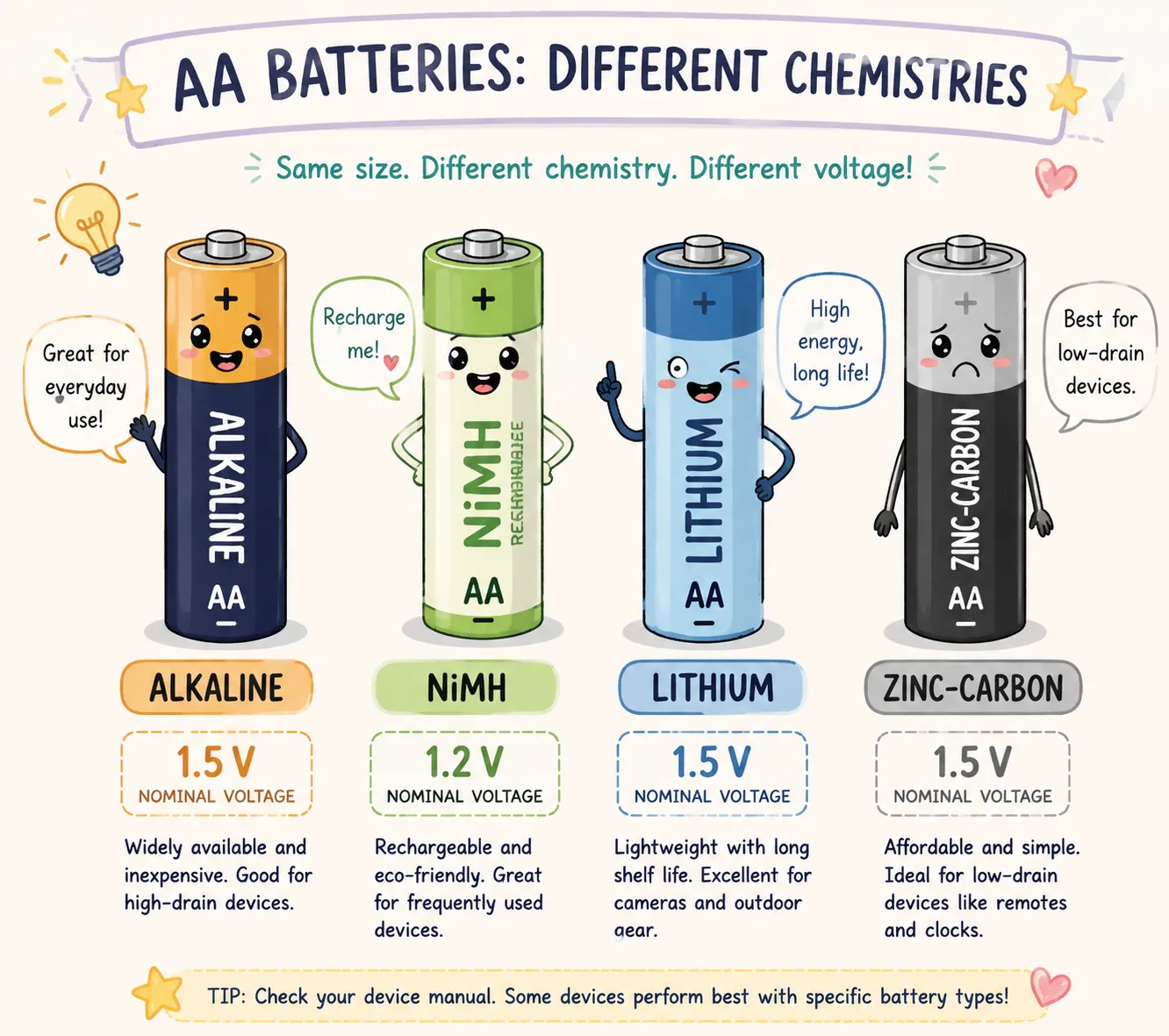
Not all AA batteries are created equal. Battery chemistry dramatically affects voltage behavior, lifespan, and device compatibility. Understanding these differences helps consumers choose the right battery for the right situation.
| Battery Type | Typical Voltage | Rechargeable | Common Uses |
|---|---|---|---|
| Alkaline | 1.5V | No | Remotes, toys, clocks |
| NiMH | 1.2V | Yes | Cameras, controllers |
| Lithium AA | 1.5V | Usually No | Medical devices, outdoor gear |
| Zinc-Carbon | 1.5V | No | Low-power electronics |
Alkaline AA Batteries
Alkaline batteries dominate the consumer market because they are affordable and readily available. They perform especially well in low-drain devices that consume power slowly over time. TV remotes and wall clocks are perfect examples. In these applications, alkaline batteries can last months or even years.
One downside is that alkaline voltage steadily decreases throughout usage. High-drain devices can expose this weakness quickly. Digital cameras, for instance, may drain alkaline batteries rapidly because voltage drops under heavy electrical load. Users often experience sudden shutdowns even when some energy remains inside the battery.
Rechargeable NiMH Batteries
Rechargeable Nickel-Metal Hydride (NiMH) batteries usually operate at 1.2 volts nominally. Many consumers initially avoid them because they assume the lower number means lower performance. In practice, NiMH batteries often outperform alkaline batteries in power-hungry devices.
Their biggest advantage is voltage stability. Instead of gradually declining like alkaline cells, NiMH batteries hold near-constant voltage for most of their discharge cycle. They also handle high current demands much better. Gamers, photographers, and heavy electronics users often prefer rechargeables for exactly this reason.
There’s also a financial advantage. A quality rechargeable battery can survive hundreds of charging cycles, dramatically reducing long-term costs and environmental waste.
Lithium AA Batteries
Lithium AA batteries are premium-performance cells designed for demanding conditions. They maintain voltage exceptionally well, tolerate extreme temperatures, and offer long shelf life. Outdoor survival gear, emergency flashlights, and medical devices often rely on lithium batteries because reliability matters more than cost.
Fresh lithium AA batteries may measure closer to 1.7 or 1.8 volts initially. Unlike alkaline batteries, they maintain strong voltage until nearly depleted.
Zinc-Carbon Batteries
Zinc-carbon batteries are older, cheaper technology. They still provide around 1.5 volts nominally but offer lower capacity and weaker performance compared to alkaline batteries. These are usually found in budget electronics or temporary-use applications where cost matters more than runtime.
What Happens When Batteries Are Connected Together
Connecting multiple batteries changes the electrical behavior of the circuit. This is where many people become confused because voltage and capacity do not always increase the same way.
Series Battery Connections Explained
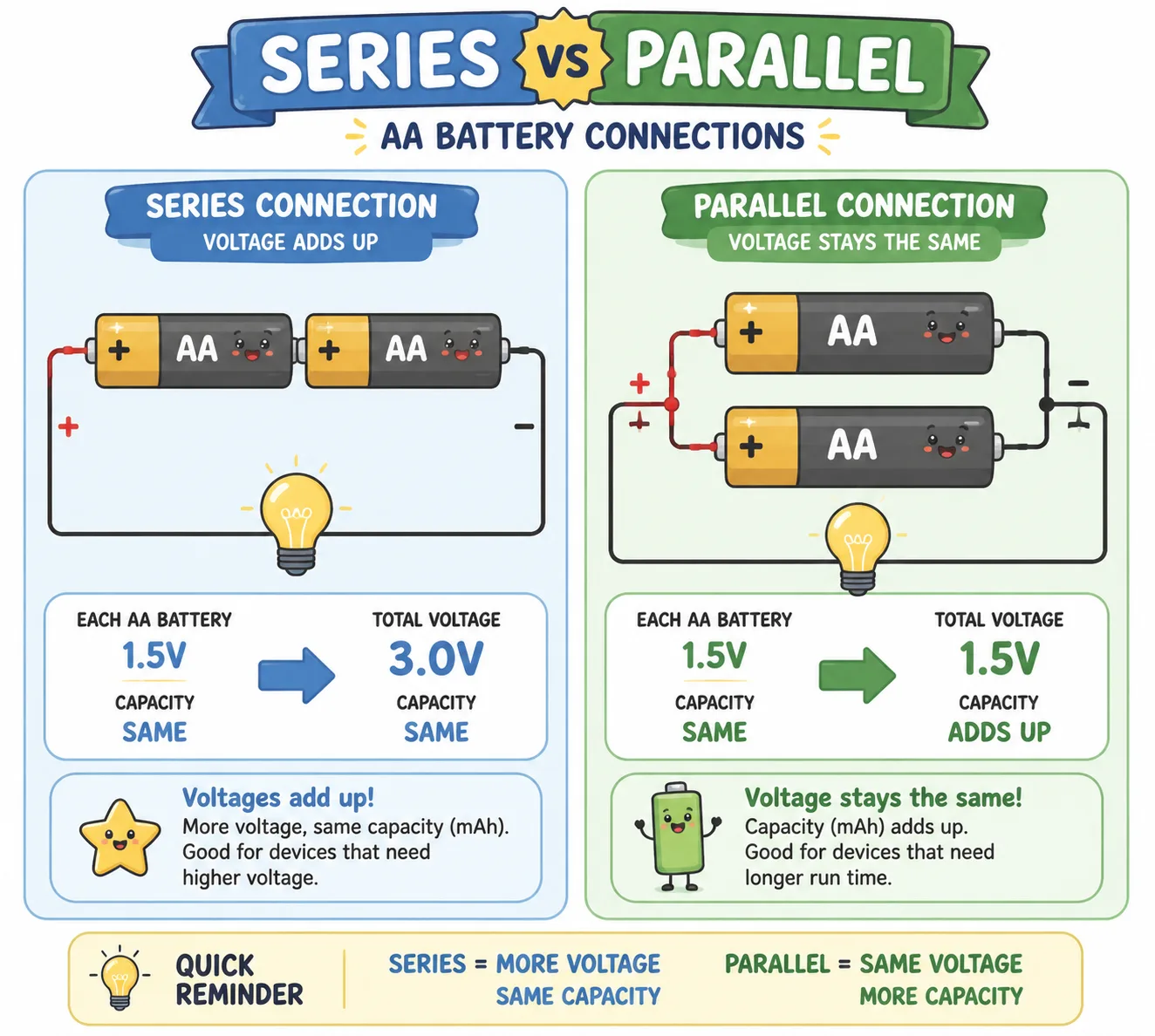
In a series connection, batteries are connected end-to-end so the voltage adds together.
Vtotal=V1+V2+V3+⋯V_{total}=V_1+V_2+V_3+cdots
Two 1.5V AA batteries connected in series produce approximately 3 volts. Four batteries create roughly 6 volts. This arrangement is extremely common in electronics because many devices require more voltage than a single AA battery can provide.
Voltage Addition in Series Circuits
Imagine stacking water pumps together in a pipeline. Each pump increases the pressure further. Batteries in series work similarly. Voltage acts like electrical pressure, so combining batteries increases the force pushing electricity through the circuit.
This configuration is common in:
- Flashlights
- Portable radios
- Toys
- Battery-powered tools
- Game controllers
The important detail is that capacity does not significantly increase in a pure series connection. The runtime depends mainly on the capacity of the individual cells.
Parallel Battery Connections Explained
Parallel connections work differently. Instead of increasing voltage, they increase total energy capacity.
Vparallel=VsingleV_{parallel}=V_{single}
When batteries are connected in parallel, the voltage stays the same while runtime increases. Two 1.5V batteries connected in parallel still provide 1.5 volts, but the device can run longer because more total energy is available.
Capacity Increase Without Voltage Increase
Think of parallel batteries like adding extra fuel tanks to a vehicle without changing engine power. The vehicle travels farther, but the speed remains the same. In electrical systems, voltage remains constant while current capacity increases.
Parallel arrangements are common in backup power systems and battery banks where extended runtime matters more than higher voltage.
Why Voltage Matters in Electronic Devices
Voltage compatibility is critical because electronics are designed to operate within specific ranges. Too little voltage causes malfunction. Too much voltage can permanently damage components.
Devices Sensitive to Battery Voltage
Some electronics tolerate wide voltage fluctuations, while others are extremely sensitive. Wall clocks and remote controls usually function fine even as battery voltage declines significantly. Digital cameras and wireless transmitters, however, often shut down early because they require stable voltage for internal processors and motors.
Medical equipment can be especially voltage-sensitive. Blood glucose monitors, thermometers, and emergency devices rely on accurate battery output to maintain reliability.
High-Drain vs Low-Drain Electronics
High-drain devices consume energy rapidly. These include:
- Digital cameras
- Gaming controllers
- LED flashlights
- Wireless microphones
- Motorized toys
Low-drain devices consume power slowly:
- Wall clocks
- TV remotes
- Smoke detectors
- Calculators
Rechargeable batteries typically excel in high-drain electronics because their voltage remains more stable under heavy loads.
Measuring AA Battery Voltage Correctly
Testing battery voltage with a multimeter is one of the easiest ways to evaluate battery health. It’s surprisingly simple once you understand the process.
Using a Multimeter Step by Step
To measure a AA battery:
- Set the multimeter to DC voltage mode.
- Touch the red probe to the positive terminal.
- Touch the black probe to the negative terminal.
- Read the displayed voltage.
Fresh alkaline batteries typically read between 1.55V and 1.65V. Rechargeable NiMH batteries often show around 1.3V to 1.4V shortly after charging.
A battery reading below 1.0 volts is usually considered nearly depleted for most consumer electronics.
Understanding Healthy Voltage Ranges
| Battery Condition | Alkaline Voltage |
|---|---|
| Brand New | 1.55V – 1.65V |
| Normal Use | 1.2V – 1.5V |
| Nearly Dead | 0.9V – 1.0V |
Understanding these ranges prevents unnecessary battery disposal. Many batteries thrown away still contain usable energy for low-drain devices.
Why Battery Voltage Drops During Use
Battery voltage decline is a natural consequence of chemical energy conversion. As internal reactants are consumed, the battery becomes less capable of sustaining electrical pressure.
Chemical Reactions Inside Batteries
Every battery works through electrochemical reactions. During discharge, active chemicals slowly convert into lower-energy compounds. This reduces the battery’s ability to push electrons through the circuit.
E=VQE=VQ
As internal resistance rises, voltage under load begins to sag. High-drain devices expose this effect quickly because they demand large amounts of current all at once.
Temperature and Load Effects
Cold weather dramatically impacts battery performance. Low temperatures slow chemical reactions, reducing effective voltage output. This is why flashlights often appear weaker during winter camping trips.
Heavy electrical loads also accelerate voltage drop. Devices with motors or bright LED systems place intense demands on batteries, causing noticeable voltage sag even when the battery still contains significant stored energy.
Lithium batteries generally outperform alkaline batteries in extreme temperatures because their chemistry remains more stable under harsh conditions.
Common Misunderstandings About Battery Ratings
Battery marketing and labeling create plenty of misconceptions among consumers.
Bigger Batteries Do Not Always Mean Higher Voltage
Many people assume D batteries produce more voltage than AA batteries because they are physically larger. In reality, both alkaline AA and D cells typically produce the same 1.5 volts. The larger battery simply stores more energy and lasts longer.
This misunderstanding is similar to confusing the size of a fuel tank with engine horsepower. Capacity and voltage are separate concepts.
Rechargeable Batteries Are Not “Weaker”
The most common misconception is that 1.2V rechargeable batteries are weaker than 1.5V alkalines. Real-world performance often proves the opposite. Rechargeables maintain stable voltage under heavy loads and can outperform alkalines in demanding devices.
Some electronics estimate battery percentage using voltage alone, which creates misleading readings. A fully charged NiMH battery may appear partially depleted because the device expects alkaline voltage levels. That does not mean the rechargeable battery lacks power.
Conclusion
AA batteries may seem simple, but the science behind them is surprisingly sophisticated. A standard alkaline AA battery usually provides 1.5 volts, while rechargeable NiMH batteries typically operate around 1.2 volts. Those numbers, however, represent only part of the story. Actual voltage constantly changes depending on chemistry, electrical load, temperature, and discharge state.
Understanding the difference between series and parallel connections helps explain why some devices use multiple batteries and how voltage can increase when cells are combined together. Measuring battery voltage with a multimeter also gives valuable insight into battery health and device compatibility.
The biggest takeaway is that voltage alone does not determine battery quality. Stable performance, energy capacity, and discharge behavior matter just as much. Rechargeable batteries labeled at 1.2 volts are not inferior. In many high-drain devices, they actually outperform traditional alkaline batteries because they maintain voltage more effectively under load.
The next time you install batteries into a flashlight, remote, or gaming controller, you’ll know exactly what those voltage ratings really mean; and why that tiny number printed on the battery label matters so much.
FAQs
1. How many volts does a single AA battery have?
A standard alkaline AA battery typically has a nominal voltage of 1.5 volts, while rechargeable NiMH AA batteries usually provide 1.2 volts.
2. How many volts do two AA batteries produce together?
If connected in series, two 1.5V AA batteries produce approximately 3 volts total.
3. Why are rechargeable AA batteries only 1.2V?
Rechargeable batteries use different chemistry, mainly NiMH technology, which naturally operates at lower nominal voltage while maintaining more stable performance during discharge.
4. At what voltage is a AA battery considered dead?
Most alkaline AA batteries are considered depleted around 0.9 to 1.0 volts, though some low-drain devices may still function below that range.
5. Can I use rechargeable batteries instead of alkaline batteries?
Yes. Most devices designed for alkaline batteries work perfectly with rechargeable NiMH batteries, especially high-drain electronics like cameras and gaming controllers.

Colt Marlowe is a 29-year-old American content writer based in Boise, Idaho. He specializes in technology, digital tools, and online business topics, combining years of research with practical experience to produce clear, trustworthy articles. As a contributor to wirelogic.online, he focuses on creating well-researched, reader-friendly content that emphasizes accuracy, transparency, and long-term value for audiences seeking reliable information.