
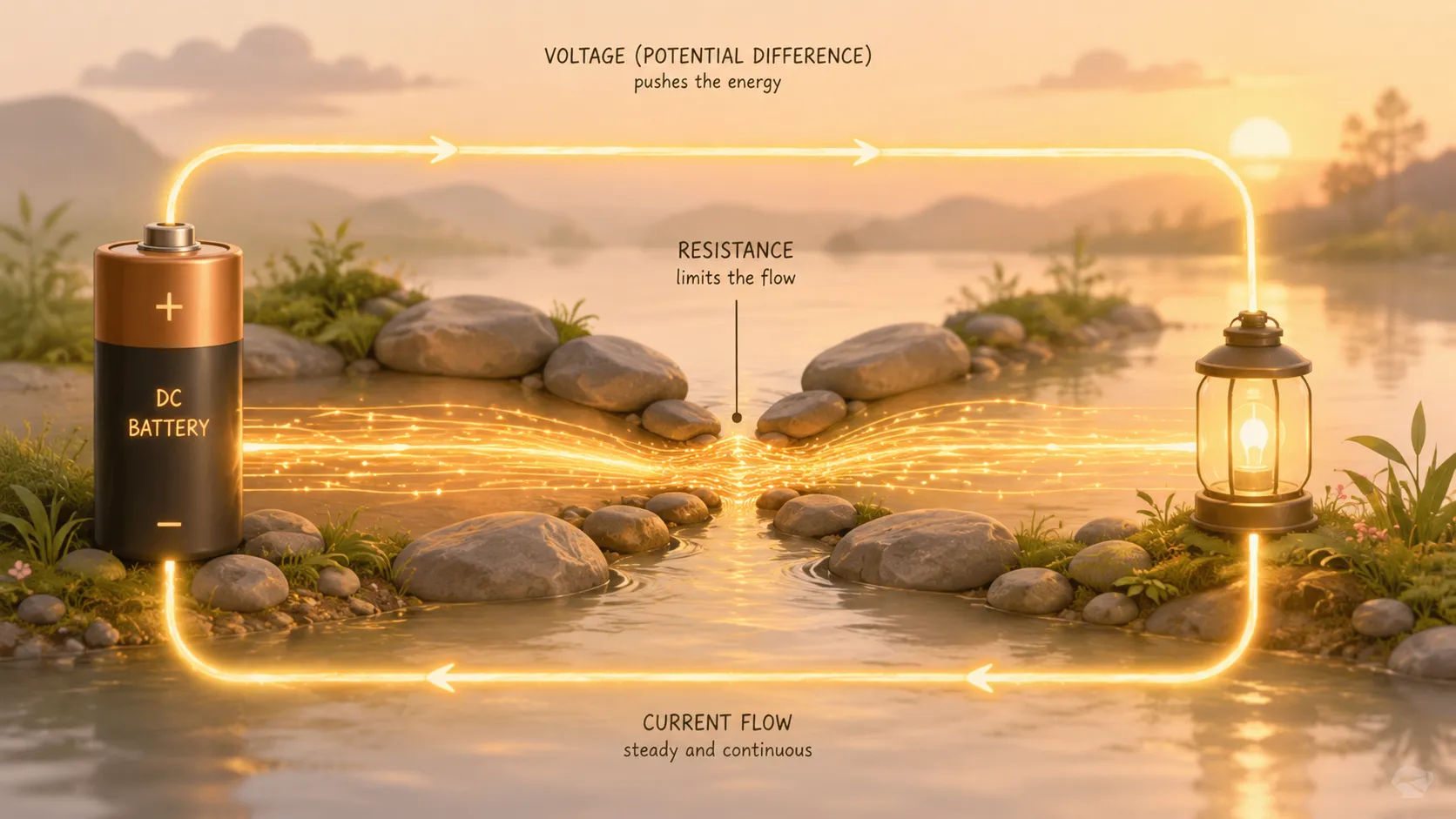
If you’ve ever used a battery-powered device; your phone, a flashlight, or even a laptop; you’ve already interacted with direct current (DC). Unlike alternating current (AC), which constantly changes direction, DC flows steadily in one direction. Think of it like water flowing through a straight pipe without reversing course. This steady movement makes DC circuits predictable and easier to analyze, especially when learning how current behaves.
A DC circuit typically consists of a power source (like a battery), conductive paths (wires), and a load (such as a bulb or motor). When the circuit is complete, electrons begin moving from the negative terminal to the positive terminal, creating current flow. But here’s the catch; this flow isn’t unlimited. Something always controls or restricts how much current can pass through the circuit.
Key Components in a DC Circuit
Every DC circuit relies on a few essential elements working together. The power source provides voltage, which pushes electrons through the circuit. The load consumes electrical energy to perform a task, like lighting a bulb or spinning a motor. Then there are conductors, typically wires, that allow electrons to move between components.
But hidden within all these components is something crucial; resistance. Even wires, which seem like perfect conductors, have some resistance. This resistance plays a major role in limiting current flow, preventing circuits from becoming dangerous or inefficient. Without it, electrical systems would quickly overheat or fail entirely.
Resistance and Its Direct Effect on Current Flow
What Is Electrical Resistance?
Resistance is essentially the opposition to the flow of electric current. Imagine trying to walk through a crowded hallway; the more people there are, the harder it is to move quickly. That’s exactly how resistance works for electrons. The higher the resistance, the more difficult it is for current to flow.
Materials with high resistance, like rubber or plastic, are called insulators. On the other hand, materials like copper and aluminum have low resistance and are excellent conductors. However, even the best conductors aren’t perfect; they still resist current to some extent.
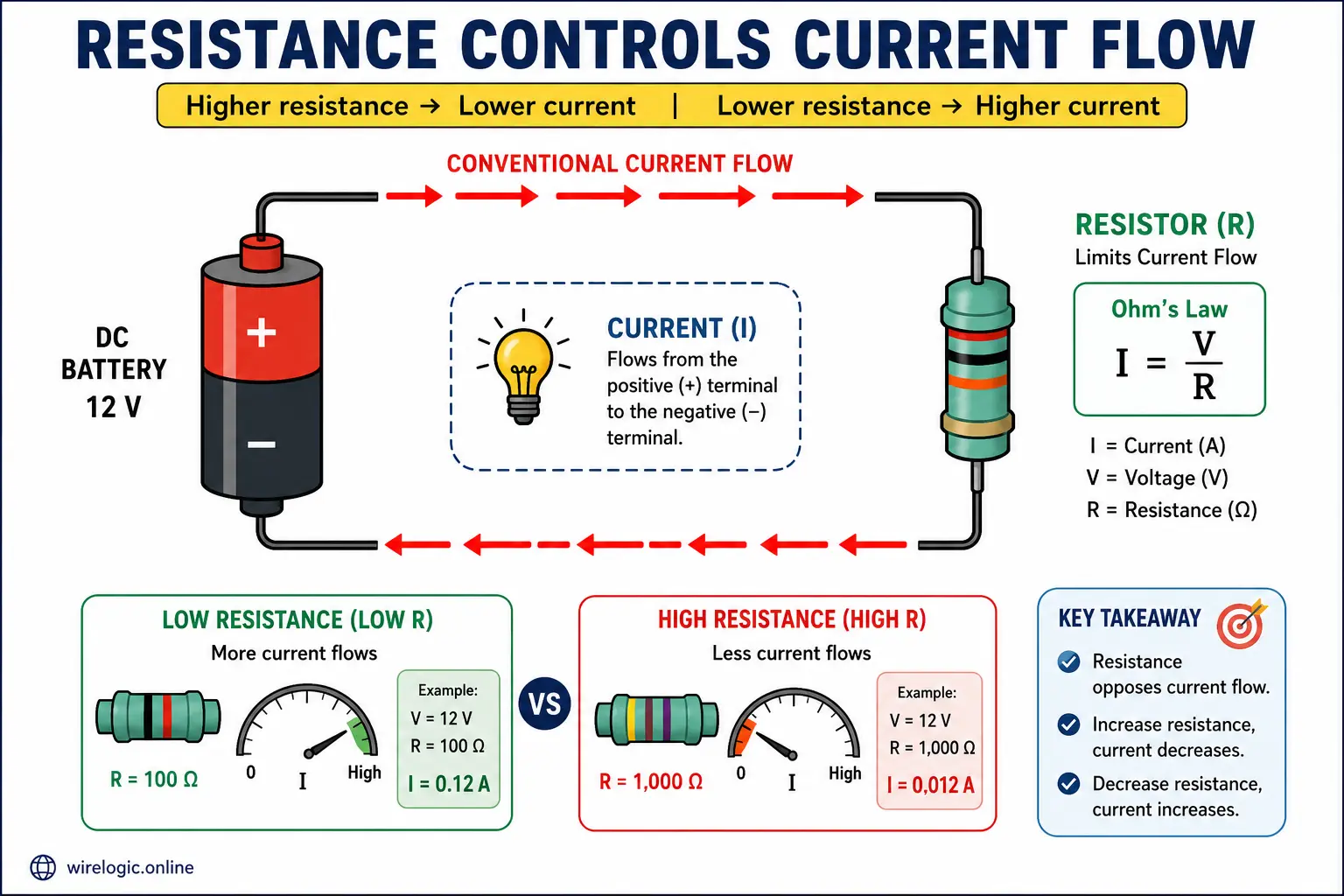
Resistance is measured in ohms (Ω), and it directly affects how much current flows in a circuit. Increase the resistance, and the current decreases. Reduce the resistance, and the current increases. It’s a simple but powerful relationship that forms the foundation of electrical engineering.
Ohm’s Law Explained Simply
At the heart of understanding current flow lies Ohm’s Law, one of the most important principles in electronics. It states:
Current (I) = Voltage (V) ÷ Resistance (R)
This means that current depends directly on voltage and inversely on resistance. If you increase the voltage while keeping resistance constant, current increases. If you increase resistance while keeping voltage constant, current decreases.
This relationship isn’t just theoretical; it’s used every day in designing circuits, from tiny electronic devices to massive industrial systems. Engineers rely on Ohm’s Law to ensure circuits operate safely and efficiently.
Real-Life Analogy for Resistance
Think of a garden hose. The water pressure represents voltage, the flow of water represents current, and any blockage or narrowing in the hose represents resistance. If you squeeze the hose (increase resistance), less water flows. If you widen it (reduce resistance), more water flows. Simple, right?
The Relationship Between Voltage, Current, and Load
Voltage as the Driving Force
Voltage is often described as the “push” that drives electrons through a circuit. Without voltage, there would be no current. It’s similar to water pressure in a pipe; higher pressure means more flow.
In a DC circuit, increasing voltage generally increases current, assuming resistance stays the same. That’s why higher-voltage batteries can power more demanding devices. But voltage alone doesn’t determine current; resistance and load also play critical roles.
Load and Its Impact on Current
The load is any component that consumes electrical energy, such as a resistor, motor, or light bulb. Different loads have different resistance values, which directly affect how much current flows.
For example, a small LED light requires very little current, while a motor may require much more. If you connect a low-resistance load to a power source, it will draw more current. Conversely, a high-resistance load will draw less current.
Understanding this relationship is essential when designing circuits. Choosing the wrong load can lead to excessive current, overheating, or even damage to components.
Why Wire Size Can Influence Circuit Performance
Thickness and Resistance
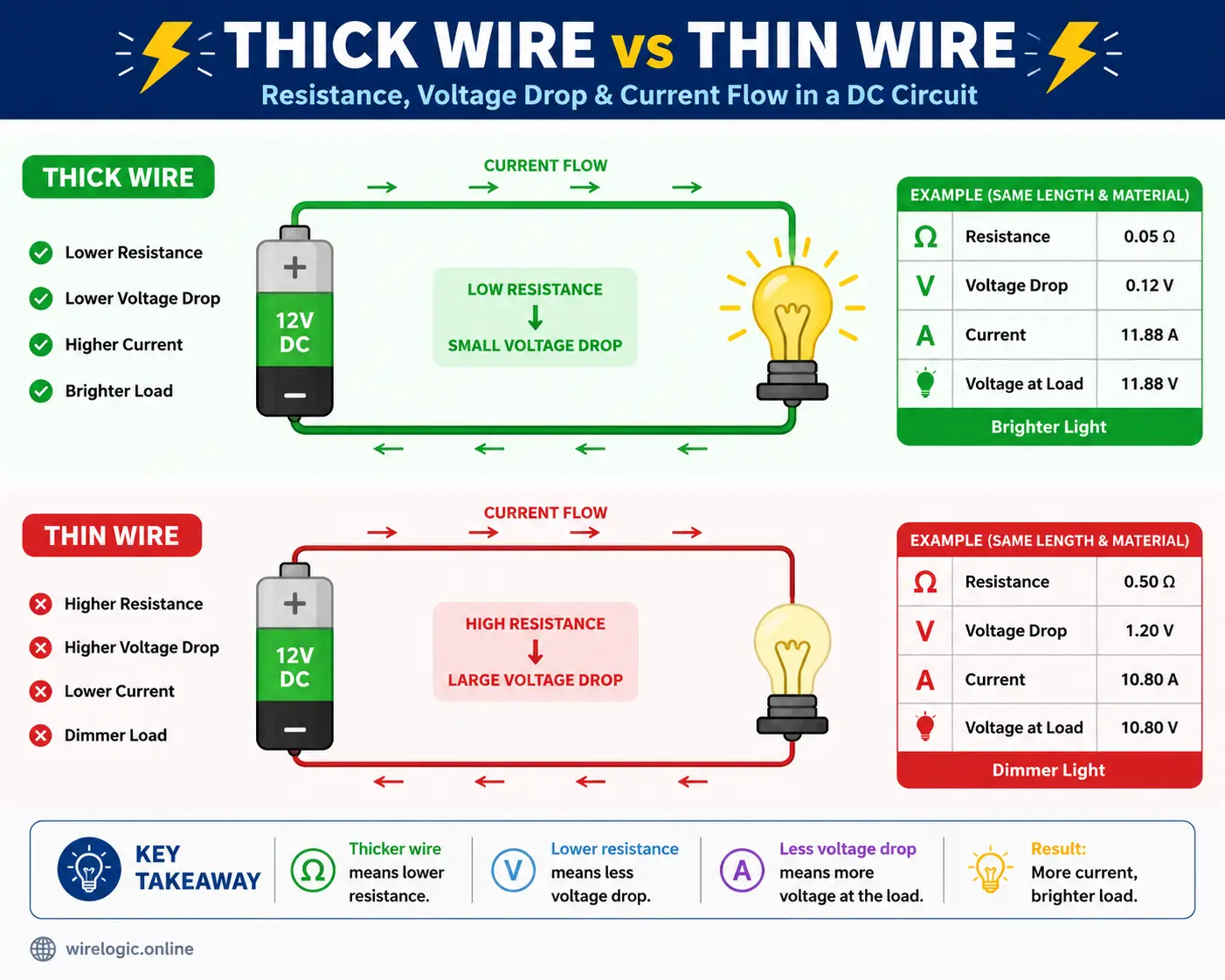
Not all wires are created equal. The thickness (or gauge) of a wire has a direct impact on its resistance. Thicker wires have lower resistance, allowing more current to flow بسهولة. Thinner wires, on the other hand, have higher resistance, which restricts current.
This is why high-power devices require thicker wires. If you try to pass a large current through a thin wire, it can overheat and potentially cause a fire. Engineers carefully select wire sizes based on the expected current to ensure safety and efficiency.
Voltage Drop in Wires
Another important factor is voltage drop, which occurs when voltage decreases as current travels through a wire. This happens because some energy is lost due to resistance in the wire itself.
In long circuits, voltage drop can become significant, reducing the performance of devices at the end of the line. Using thicker wires helps minimize this effect, ensuring that the load receives the proper voltage.
Heat Generation Inside High Resistance Components
Why Heat Is Produced
Whenever current flows through a مقاومة (resistance), heat is generated. This phenomenon is known as Joule heating. The higher the resistance, the more heat is produced for a given current.
This is actually useful in some applications, like electric heaters and toasters. However, in most circuits, excessive heat is undesirable because it can damage components.
Risks of Excessive Heat
Too much heat can lead to insulation failure, component damage, or even fires. That’s why circuits are designed to limit current and manage heat effectively. Components are often rated for specific power levels to ensure they can handle the الحرارة generated during operation.
What Happens During a Short Circuit Condition
Definition of a Short Circuit
A short circuit occurs when current takes an unintended path with very low resistance. This usually happens when wires touch directly or when insulation fails.
In a short circuit, resistance drops dramatically, causing current to spike بشكل كبير. According to Ohm’s Law, if resistance approaches zero, current becomes extremely high.
Effects on Current Flow
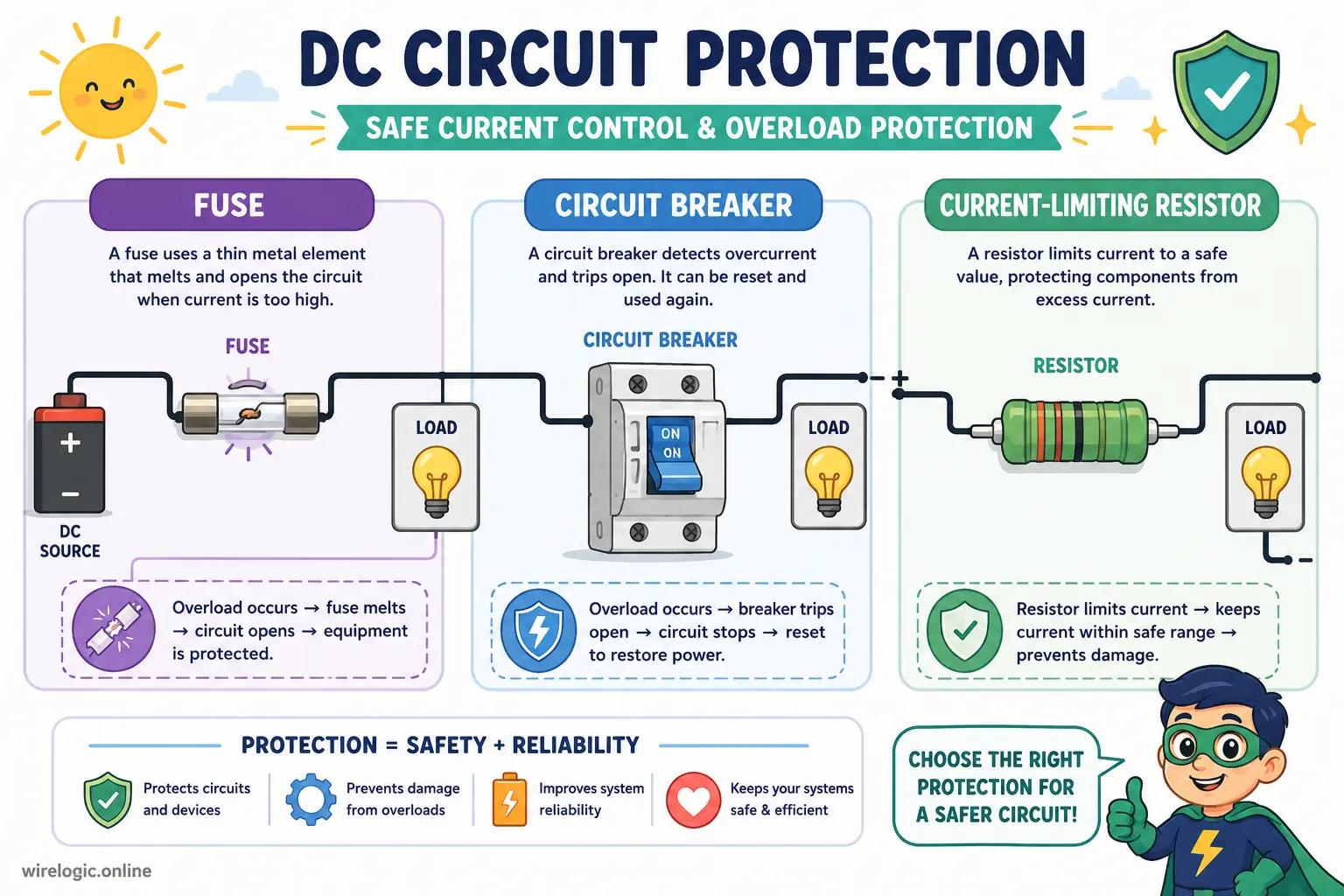
This sudden surge in current can damage components, melt wires, and even cause fires. That’s why protective devices like fuses and circuit breakers are essential. They interrupt the circuit when current exceeds safe levels, preventing catastrophic damage.
How Power Supplies Restrict Excessive Current
Current Limiting Mechanisms
Modern power supplies are designed with built-in current limiting features. These mechanisms ensure that current does not exceed a safe level, even if the load changes or a fault occurs.
Some power supplies use electronic circuits to monitor and adjust current automatically. Others rely on passive components like resistors to limit current flow.
Protective Devices in Circuits
Common protective devices include:
- Fuses, which melt when current exceeds a certain level
- Circuit breakers, which automatically disconnect the circuit
- Current-limiting resistors, which restrict current flow
These devices act as safety nets, ensuring that circuits remain stable and safe under مختلف الظروف.
Real-World Examples of Current Limiting in DC Systems
Everyday Applications
You encounter current limiting every day, often without realizing it. Phone chargers regulate current to prevent battery damage. LED lights use resistors to control current and prevent burnout. Even your car’s electrical system relies on current limiting to protect sensitive electronics.
These systems are carefully designed to balance performance and safety, ensuring devices operate efficiently without خطر.
Industrial and Automotive Systems
In industrial settings, current limiting is critical for protecting expensive equipment. Motors, transformers, and control systems all rely on precise current regulation. In السيارات, current limiting prevents damage to wiring and الإلكترونية components, especially during startup when current demands are high.
These real-world examples highlight how essential current limiting is in modern technology. Without it, our الأجهزة would be unreliable and potentially dangerous.
Conclusion
Understanding what limits current flow in a DC circuit is fundamental to both basic electronics and advanced engineering. Resistance plays the primary role, acting as a gatekeeper that controls how much current can pass. Voltage provides the driving force, while the load determines how much current is needed. Add in factors like wire size, heat generation, and protective mechanisms, and you get a complete picture of how DC circuits operate safely and efficiently.
When all these elements work together, they create stable, predictable systems that power everything from small gadgets to large industrial machines. The next time you plug in a device or flip a switch, you’ll know there’s a carefully balanced system controlling every electron behind the scenes.
FAQs
1. What is the main factor that limits current in a DC circuit?
The primary factor is resistance, which opposes the flow of current and determines how much can pass through the circuit.
2. Can increasing voltage increase current?
Yes, increasing voltage will increase current if resistance remains constant, according to Ohm’s Law.
3. Why do thin wires heat up more easily?
Thin wires have higher resistance, which causes more heat generation when current flows through them.
4. What is the danger of a short circuit?
A short circuit causes extremely high current, which can damage components, melt wires, and start fires.
5. How do power supplies protect circuits from high current?
They use current limiting features and protective devices like fuses and circuit breakers to prevent excessive current flow.