

Copper is one of those metals that quietly powers the modern world. It sits inside electrical wiring, motors, electronics, industrial machines, plumbing systems, renewable energy equipment, and even massive power grids. Yet many people never stop to ask a surprisingly fascinating question: what is the freezing point of copper? The answer matters far more than you might think because industries across the globe depend on copper changing from liquid to solid at exactly the right temperature.
The freezing point of pure copper is approximately 1084.62°C (1984.32°F or 1357.77 K) under standard atmospheric pressure. This is the temperature where molten copper solidifies into a crystalline metal structure. Interestingly, the freezing point and melting point of copper are essentially the same because pure metals transition sharply between solid and liquid states.
<math xmlns=”Tfreeze=1084.62∘C=1984.32∘F=1357.77 KT_{freeze}=1084.62^circ C=1984.32^circ F=1357.77 K
Think of molten copper like a crowd of energetic dancers moving wildly in every direction. As the temperature drops toward the freezing point, the dancers gradually slow down and organize themselves into a highly ordered structure. That organization process is what turns glowing liquid copper into solid metal. Unlike materials such as glass or plastic that soften gradually, copper undergoes a very distinct phase transition.
Scientists and engineers pay close attention to this temperature because even small variations can affect the quality of castings, wires, industrial parts, and electronic components. High-purity copper has an extremely predictable freezing point, which is one reason it is often used in temperature calibration systems for industrial thermometers and scientific equipment. According to metallurgy references and engineering sources, copper’s freezing plateau is so stable that it serves as a fixed calibration point in international temperature standards.
The Exact Temperature Where Copper Changes From Liquid to Solid
When people talk about copper “freezing,” they sometimes imagine icy conditions, but metal freezing is completely different from water freezing. Copper solidifies at temperatures hot enough to glow bright orange inside industrial furnaces. At approximately 1085°C, liquid copper begins transforming into a rigid metallic crystal structure.
This process does not happen randomly. As molten copper cools, atoms lose kinetic energy and begin arranging themselves into orderly crystal lattices. During this transition, the temperature briefly stabilizes because the metal releases latent heat. This is similar to how water remains at 0°C while freezing into ice, even though energy is still leaving the system.
One fascinating detail is how precisely this temperature can be measured. Scientific sources report the freezing point with remarkable consistency because pure copper behaves predictably under controlled conditions. Industrial metallurgy references often round the figure to 1085°C, while scientific standards provide more precise values such as 1084.62°C.
In practical manufacturing, operators usually heat copper beyond its melting point before pouring it into molds. Why? Because molten copper cools quickly once removed from the furnace. Foundry workers know that if the temperature falls too close to the freezing point during pouring, the copper may solidify too early and ruin the casting. Discussions among metal casters frequently mention the challenge of keeping copper hot enough for smooth pours because copper loses heat rapidly.
Why Freezing Point and Melting Point Are the Same for Pure Metals
This idea confuses many people at first. How can copper have the same melting point and freezing point? The answer comes down to the direction of heat flow rather than different temperatures.
When solid copper absorbs enough heat to reach 1084.62°C, it melts into liquid metal. When liquid copper cools to the same temperature, it freezes into solid metal again. The physical transformation reverses, but the equilibrium temperature remains identical. This behavior is common in pure substances.
You can imagine it like a doorway between two rooms. Whether you walk from Room A to Room B or from Room B to Room A, the doorway itself does not change position. Copper’s phase transition temperature works the same way. The transition simply depends on whether heat is entering or leaving the material.
Pure metals are especially interesting because they usually transition at a single, sharply defined temperature. Copper does not gradually soften over a wide range like some alloys do. That sharp transition is one reason copper is so valuable in industrial processes requiring precision and repeatability.
Why Copper Has Such a High Freezing Point
Copper’s freezing point is dramatically higher than many everyday metals. Aluminum melts at around 660°C, while copper freezes at nearly 1085°C. That enormous temperature difference explains why melting copper requires far more energy and more powerful furnaces than melting aluminum.
Strong Metallic Bonding in Copper
The main reason copper has a high freezing point is its strong metallic bonding. Copper atoms share a “sea” of free-moving electrons that hold the structure together very tightly. Breaking those bonds requires a huge amount of thermal energy.
<math xmlns=”Cu(l)→Cu(s)+latent heatCu_{(l)} rightarrow Cu_{(s)} + text{latent heat}
In metallic bonding, electrons move relatively freely between atoms, almost like glue holding the metal together. Copper’s electrons create exceptionally stable bonding forces, which means the atoms resist separation until temperatures become extremely high. This stability is also why copper has outstanding electrical and thermal conductivity.
You can compare it to dismantling a tightly woven steel cable versus pulling apart a loose rope. The stronger the connections, the more force required to separate them. Copper’s atomic structure behaves like that tightly woven cable at the microscopic level.
This strong bonding also explains why copper remains structurally stable in demanding environments. Industrial equipment, electrical systems, and high-temperature applications rely on copper because it can tolerate significant heat without deforming or melting unexpectedly.
Atomic Structure and Thermal Stability
Copper’s atomic arrangement contributes heavily to its thermal behavior. The atoms pack into a face-centered cubic crystal structure, which is both stable and efficient. This arrangement allows copper to maintain strength while still remaining ductile and workable.
As copper cools from its molten state, atoms naturally organize themselves into repeating crystal patterns. The orderly structure helps explain why solid copper has excellent conductivity and mechanical consistency. Engineers closely monitor cooling conditions because the speed of solidification affects grain size, strength, and conductivity.
Slow cooling often produces larger grains, while rapid cooling creates finer grain structures. Those microscopic differences can influence how copper performs in electrical wiring, industrial machinery, or structural applications. A simple temperature adjustment during cooling can completely change the final material properties.
What Happens to Copper During Cooling
Watching molten copper cool is almost like observing a miniature geological event. Bright orange liquid gradually darkens, stiffens, and crystallizes into solid metal. Beneath the surface, however, incredibly complex changes are happening at the atomic level.
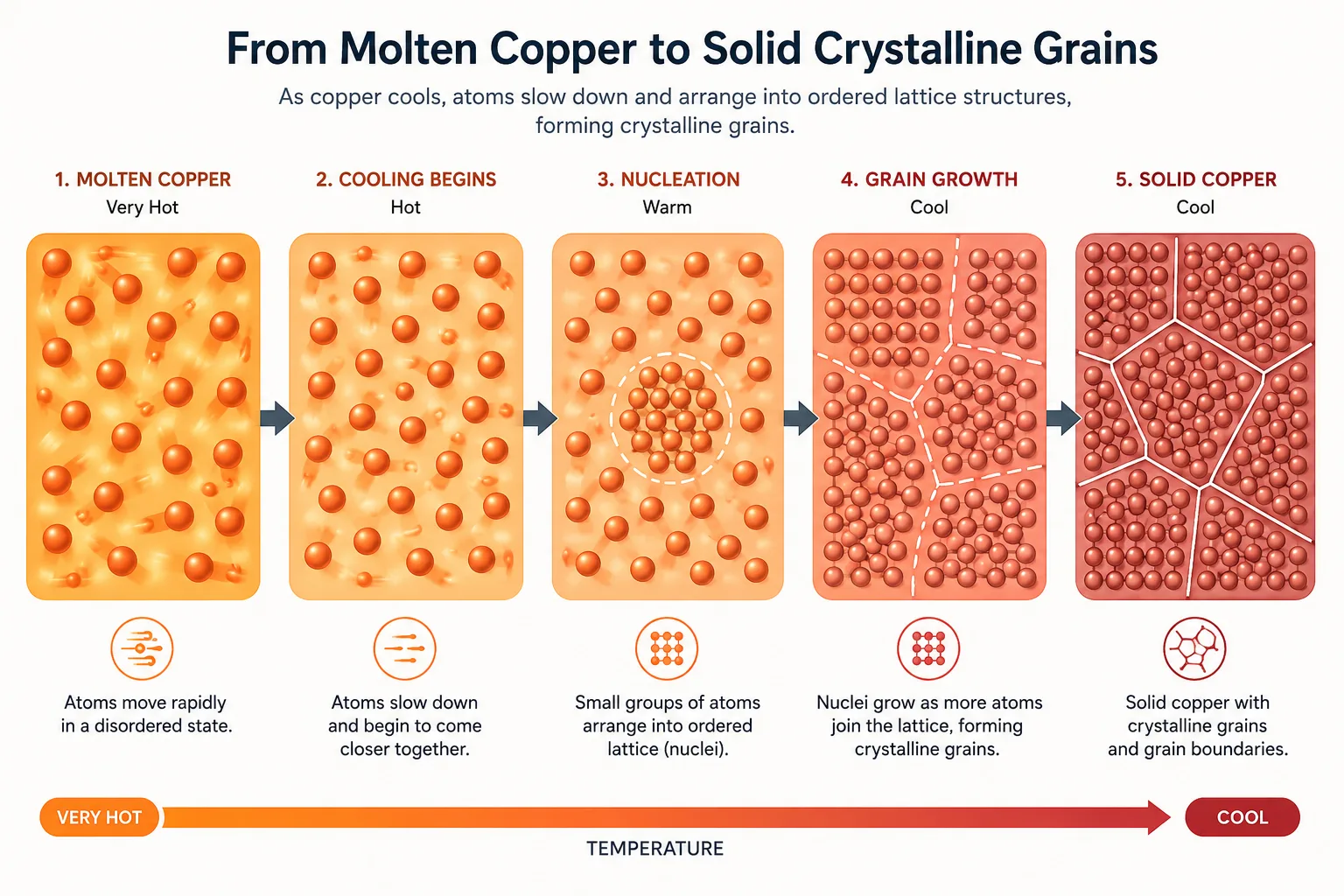
The Transition From Molten Copper to Solid Metal
Molten copper contains highly energetic atoms moving freely in random directions. As temperature decreases, atomic movement slows until the atoms can no longer remain in liquid form. At the freezing point, they begin locking into crystalline structures.
During this transition, copper releases latent heat. That means the temperature temporarily stabilizes even while the metal continues changing state. Industrial cooling curves often show a noticeable plateau during copper solidification because energy is being released internally.
Foundry workers carefully monitor this stage because improper cooling can create defects like cracks, voids, shrinkage cavities, or weak grain structures. Cooling too quickly may trap stresses inside the metal, while cooling too slowly can create oversized grains that weaken mechanical properties.
This is why industrial casting often feels part science and part art. Experienced metallurgists understand that copper’s final quality depends not only on composition but also on how the cooling process is controlled second by second.
Crystal Formation and Grain Structure
As copper freezes, tiny crystals called grains begin forming throughout the liquid metal. These grains grow outward until they meet neighboring grains, creating the final solid structure.
The grain pattern matters enormously. Fine grains generally improve strength and toughness, while coarse grains may reduce durability. Manufacturers manipulate cooling rates specifically to control grain development.
Imagine pouring wet concrete into a mold. The final texture and strength depend heavily on how the material settles and cures. Copper behaves similarly, except the process occurs at atomic scales and extremely high temperatures.
Heat Release During Solidification
One fascinating aspect of copper solidification is the release of latent heat. Even though the furnace temperature may be dropping, the copper itself briefly resists further cooling during phase transition.
<math xmlns=”Q=mLfQ=mL_f
This equation represents latent heat released during freezing, where <math xmlns=”QQ
is heat energy, <math xmlns=”mm
is mass, and <math xmlns=”LfL_f
is latent heat of fusion.
This phenomenon helps explain why molten copper sometimes appears to stay liquid longer than expected. The material is actively releasing stored thermal energy while reorganizing into solid crystals. Industrial thermocouple systems monitor this plateau carefully because it reveals valuable information about purity and solidification behavior.
Industrial Processes That Depend on Copper Solidification
Modern industry would struggle to function without precise copper solidification control. Everything from electrical grids to automotive systems depends on copper components produced through carefully managed freezing and cooling processes.
Copper Casting and Foundry Operations
Copper casting is one of the most important industrial applications involving copper freezing. Foundries melt copper inside specialized furnaces and pour it into molds to create pipes, electrical connectors, machine parts, and industrial equipment.
The timing must be nearly perfect. If copper freezes too early, molds may not fill completely. If cooling occurs unevenly, defects can form inside the finished part. This is why industrial foundries carefully control mold temperatures, pouring temperatures, and cooling environments.
Copper’s high freezing point also means foundries require powerful furnaces capable of sustaining temperatures above 1100°C. Hobby metalworkers often discover that melting copper is dramatically harder than melting aluminum because the energy requirements are much greater.
Electrical Manufacturing and Copper Components
Copper dominates the electrical industry because of its unmatched conductivity and reliability. Electrical wires, transformers, motors, circuit boards, and renewable energy systems all depend heavily on high-quality copper.
During manufacturing, molten copper may be continuously cast into rods or billets before being rolled into wires and components. Maintaining proper solidification conditions is critical because internal defects can reduce conductivity and mechanical reliability.
Even microscopic impurities or poor grain structures can increase electrical resistance. That may sound minor, but across national power grids, tiny efficiency losses become economically enormous.
Welding, Brazing, and Metal Fabrication
Copper’s freezing behavior also matters in welding and brazing operations. Welders must carefully manage heat input because copper rapidly conducts heat away from the weld area.
This thermal conductivity creates challenges. Heat spreads so efficiently through copper that maintaining molten pools becomes difficult. Welders often use preheating techniques to reduce rapid heat loss and ensure proper fusion.
Fabricators working with copper alloys also monitor freezing ranges carefully because alloys do not solidify at a single temperature like pure copper. Instead, they transition gradually across temperature ranges, which changes how welds and castings behave during cooling.
How Impurities Affect Copper’s Freezing Temperature
Pure copper behaves predictably, but real-world industrial copper often contains small amounts of impurities or alloying elements. These additions can significantly alter freezing behavior.
Oxygen and Trace Element Effects
Even tiny impurity levels can shift copper’s freezing temperature. Oxygen, sulfur, phosphorus, zinc, tin, and lead all influence solidification characteristics.
High-purity copper may freeze sharply at approximately 1084.62°C, but impure copper can freeze across broader temperature ranges. Some impurities lower the freezing temperature, while others alter grain structure or cooling behavior.
Industrial metallurgy references explain that alloying elements disrupt the orderly arrangement of copper atoms, making it harder for crystals to form uniformly.
This matters enormously in manufacturing because inconsistent solidification can create weak spots or conductivity issues. Precision industries such as aerospace and electronics therefore use carefully controlled copper grades with extremely high purity levels.
Copper Alloys and Variable Freezing Ranges
Copper alloys behave differently from pure copper. Brass, bronze, and other copper-based alloys usually freeze across ranges rather than single temperatures.
Here is a quick comparison:
| Metal or Alloy | Approximate Freezing/Melting Point |
|---|---|
| Pure Copper | 1084.62°C |
| Aluminum | 660°C |
| Brass | 800–950°C |
| Bronze | 850–1000°C |
| Carbon Steel | 1425–1540°C |
| Silver | 961.8°C |
| Gold | 1064°C |
Brass typically melts below pure copper because zinc lowers the transition temperature. Bronze behaves differently depending on tin concentration. These variations are why alloy selection matters so much in engineering applications.
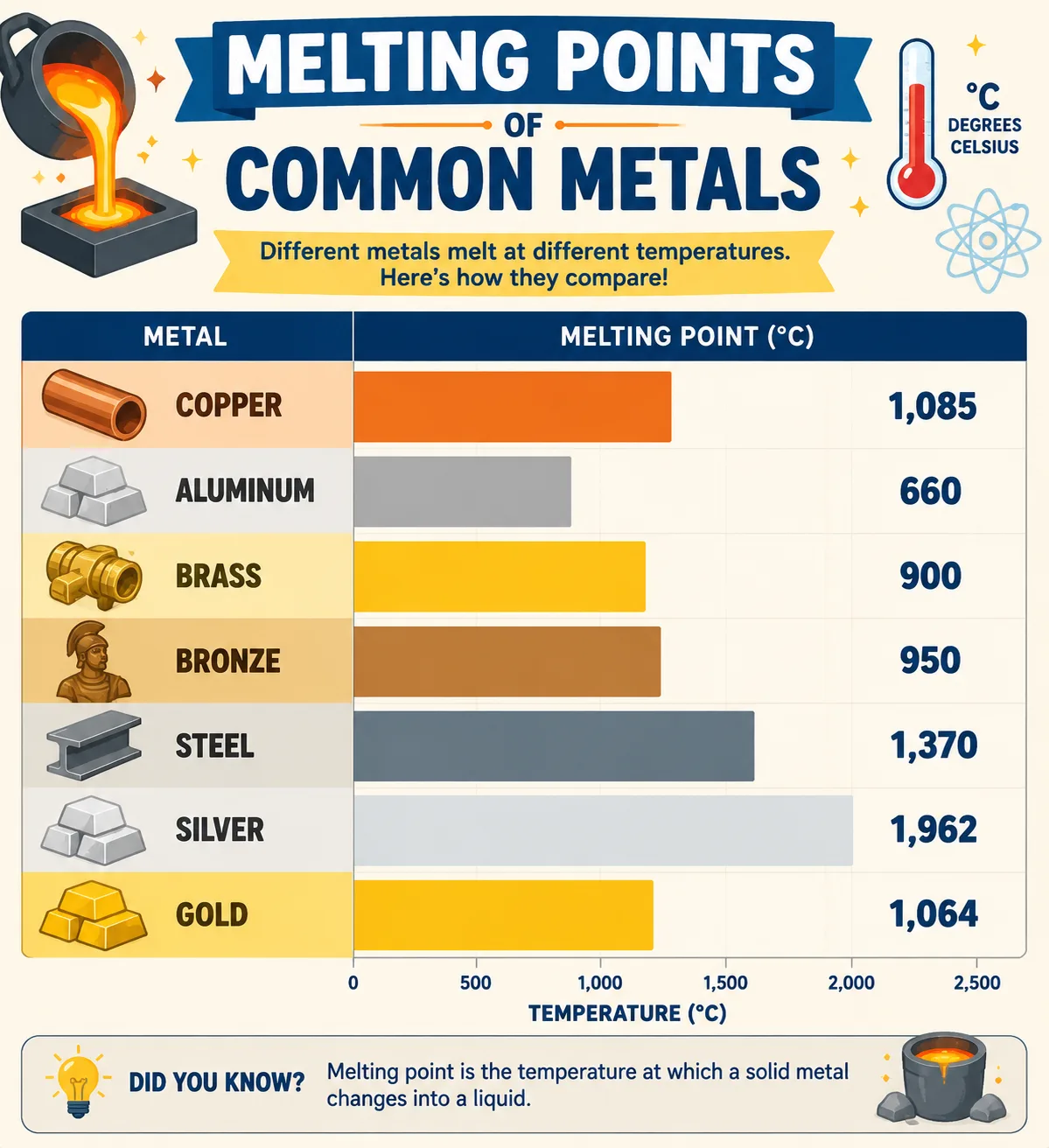
Comparing Copper With Other Common Metals
Copper sits in a fascinating middle ground among industrial metals. It has a much higher freezing point than lightweight metals like aluminum but lower temperatures than iron and steel.
Copper vs Aluminum
Aluminum melts at roughly 660°C, making it far easier to process than copper. Aluminum casting requires less energy, lower furnace temperatures, and simpler equipment.
Copper, however, offers superior conductivity and durability. The higher freezing point reflects stronger metallic bonding and greater thermal stability. That is why copper remains the preferred material for demanding electrical applications despite higher processing costs.
Copper vs Iron and Steel
Steel and iron require even more extreme temperatures than copper. Carbon steel often melts above 1400°C, making steelmaking one of the most energy-intensive industrial processes on Earth.
Copper is easier to melt than steel but still difficult enough to require specialized furnaces. This balance makes copper highly versatile across industries ranging from electronics to heavy manufacturing.
Copper vs Silver and Gold
Silver actually melts at a lower temperature than copper despite having similar conductivity properties. Gold also freezes at slightly lower temperatures.
Copper’s combination of high conductivity, moderate cost, corrosion resistance, and high freezing point gives it an incredibly valuable balance of properties. That balance is one reason copper remains one of the most widely used engineering metals in human history.
Scientific and Engineering Importance of Copper’s Freezing Point
Copper’s freezing point is not just useful for foundries and factories. Scientists also rely on it for precision measurement systems.
Temperature Calibration Standards
The freezing point of high-purity copper serves as a fixed calibration reference in thermometry systems. Industrial laboratories use copper freeze-point cells to calibrate thermocouples and high-temperature instruments.
Because copper solidifies at an extremely repeatable temperature, it provides a reliable benchmark for accurate temperature measurement. According to scientific references, properly prepared copper calibration cells can achieve precision levels within fractions of a degree.
That precision matters in industries such as aerospace, semiconductor manufacturing, scientific research, and advanced metallurgy.
Why Engineers Closely Monitor Cooling Curves
Cooling curves reveal enormous amounts of information about copper quality. Engineers analyze how temperature changes during freezing to detect impurities, phase transitions, and structural abnormalities.
A perfectly flat freezing plateau often indicates very pure copper. Irregular cooling behavior may suggest contamination or process problems.
In many ways, copper’s cooling curve acts like a fingerprint. By studying it carefully, metallurgists can diagnose manufacturing issues before finished components ever reach customers.
Conclusion
Copper’s freezing point of approximately 1084.62°C represents far more than a simple scientific number. It defines the boundary between liquid metal and solid crystalline structure, shaping industries that power modern civilization. From electrical wiring and renewable energy systems to casting operations and precision manufacturing, copper solidification plays a critical role in global technology.
The reason copper freezes at such a high temperature comes down to strong metallic bonding and stable atomic structures. Those same characteristics also give copper its legendary conductivity, durability, and industrial value. During cooling, molten copper undergoes a remarkable transformation where energetic atoms organize into ordered crystal lattices while releasing latent heat.
Industrial engineers carefully monitor copper freezing because tiny changes in cooling behavior can dramatically affect strength, conductivity, and product quality. Impurities and alloying elements further complicate the process by altering freezing ranges and grain structures.
Compared with metals like aluminum, steel, silver, and gold, copper occupies a unique position that balances conductivity, durability, and thermal stability. That balance explains why humanity continues relying on copper thousands of years after its first discovery.
FAQs
1. What is the exact freezing point of copper?
Pure copper freezes at approximately 1084.62°C (1984.32°F or 1357.77 K) under standard atmospheric pressure.
2. Is the freezing point of copper the same as its melting point?
Yes. For pure copper, the freezing point and melting point are essentially identical because the metal changes between liquid and solid phases at the same equilibrium temperature.
3. Why does copper have such a high freezing point?
Copper has strong metallic bonds and a stable atomic structure. Breaking those bonds requires very high thermal energy, resulting in a freezing point above 1000°C.
4. Do copper alloys freeze at the same temperature as pure copper?
No. Copper alloys such as brass and bronze usually freeze across temperature ranges rather than at one exact temperature because alloying elements alter atomic interactions.
5. Why is copper’s freezing point important in industry?
Industries depend on copper solidification for casting, electrical manufacturing, welding, temperature calibration, and materials engineering. Precise freezing control ensures product quality and structural reliability.