

A car battery can look perfectly healthy one moment and completely fail the next. You’ve probably seen it happen. The headlights turn on, the dashboard lights glow normally, and the multimeter says the battery still has voltage. Then suddenly, the engine struggles to crank or refuses to start altogether. That confusing situation is exactly why battery load testing exists.
A regular voltage reading only tells part of the story. A battery load test reveals whether the battery can actually deliver power when demand increases. Think of it like checking an athlete’s performance while sitting on a couch versus while sprinting uphill. Resting measurements don’t always reveal weakness. Stress does.
Modern vehicles, backup power systems, solar batteries, marine equipment, and industrial battery banks all rely on accurate battery diagnostics. As battery technology evolves in 2026, technicians and vehicle owners are increasingly relying on load testing instead of simple voltage checks because batteries can maintain surface voltage even while internal components deteriorate.
Before diving deeper into the mechanics of battery testing, let’s organize the topic clearly.
Understanding the Basic Purpose of Battery Load Testing
Battery load testing exists for one simple reason: batteries behave differently under pressure than they do at rest. A resting battery may show excellent voltage numbers while secretly lacking the ability to deliver enough current to power a starter motor, inverter, or electrical system. This difference between appearance and performance is where many battery problems hide.
Imagine filling a water balloon with tiny holes. From the outside, it still looks full. The moment pressure increases, water rushes out and weakness becomes obvious. Batteries work in a surprisingly similar way. Internal chemical degradation, sulfation, aging cells, or increased resistance may not immediately lower resting voltage, but these issues dramatically reduce performance under load.
Technicians use load testing because it simulates real-world operating conditions. During engine startup, for example, a car battery experiences a massive current demand for a few seconds. If the battery cannot maintain stable voltage during that stress, starting problems occur even if static voltage readings seem acceptable. According to recent automotive testing references, a fully charged 12V battery might display 12.6 volts at rest but collapse below 9.6 volts under heavy load if internal deterioration exists.
This is why modern diagnostics increasingly focus on voltage under load rather than open-circuit voltage alone. Mechanics, fleet managers, solar technicians, and EV specialists all understand that performance under demand tells the real story.
Why Voltage Alone Cannot Reveal Battery Health
A multimeter is useful, but it can also create false confidence. Many people assume that if a battery reads 12.6 volts, it must be healthy. In reality, voltage only measures electrical potential at that moment. It does not measure how effectively the battery can sustain current flow under stress.
Batteries naturally develop internal resistance as they age. Corrosion, sulfation, heat damage, repeated deep discharges, and chemical wear slowly interfere with energy delivery. A battery with elevated internal resistance may still maintain normal voltage while idle because little current is flowing. Once heavy demand appears, voltage suddenly collapses.
This phenomenon explains why countless drivers experience mysterious no-start conditions even after checking battery voltage. Reddit users and professional technicians alike frequently report batteries that appear “fine” until a load tester exposes severe voltage sag.
Modern diagnostic systems recognize several key metrics:
| Battery Measurement | What It Reveals |
|---|---|
| Open-circuit voltage | Current state of charge |
| Voltage under load | Real-world power delivery |
| Internal resistance | Aging and deterioration |
| Capacity (Ah) | Remaining energy storage |
| Recovery voltage | Ability to stabilize after stress |
The key takeaway is simple: a battery can hold voltage without holding strength.
The Relationship Between Load and Real Performance
Electrical systems demand current, not just voltage. Starters, inverters, compressors, winches, and EV systems all require sustained power delivery. A battery that cannot maintain stable voltage during these high-demand moments becomes unreliable.
During a load test, the tester intentionally stresses the battery to simulate real operating conditions. The heavier the load, the more internal weaknesses become visible. Healthy batteries maintain stable voltage because internal chemical reactions can keep pace with demand. Weak batteries cannot respond quickly enough, causing voltage collapse.
This principle matters even more in today’s technology-heavy vehicles. Modern cars use dozens of electronic modules, sensors, and onboard computers. EVs and hybrid systems push battery management even further. Tiny changes in resistance or voltage behavior can significantly affect reliability and performance.
Recent EV battery research also shows that increased internal resistance directly contributes to voltage instability, uneven cell performance, and accelerated degradation under heavy current draw.
How a Battery Load Test Actually Works
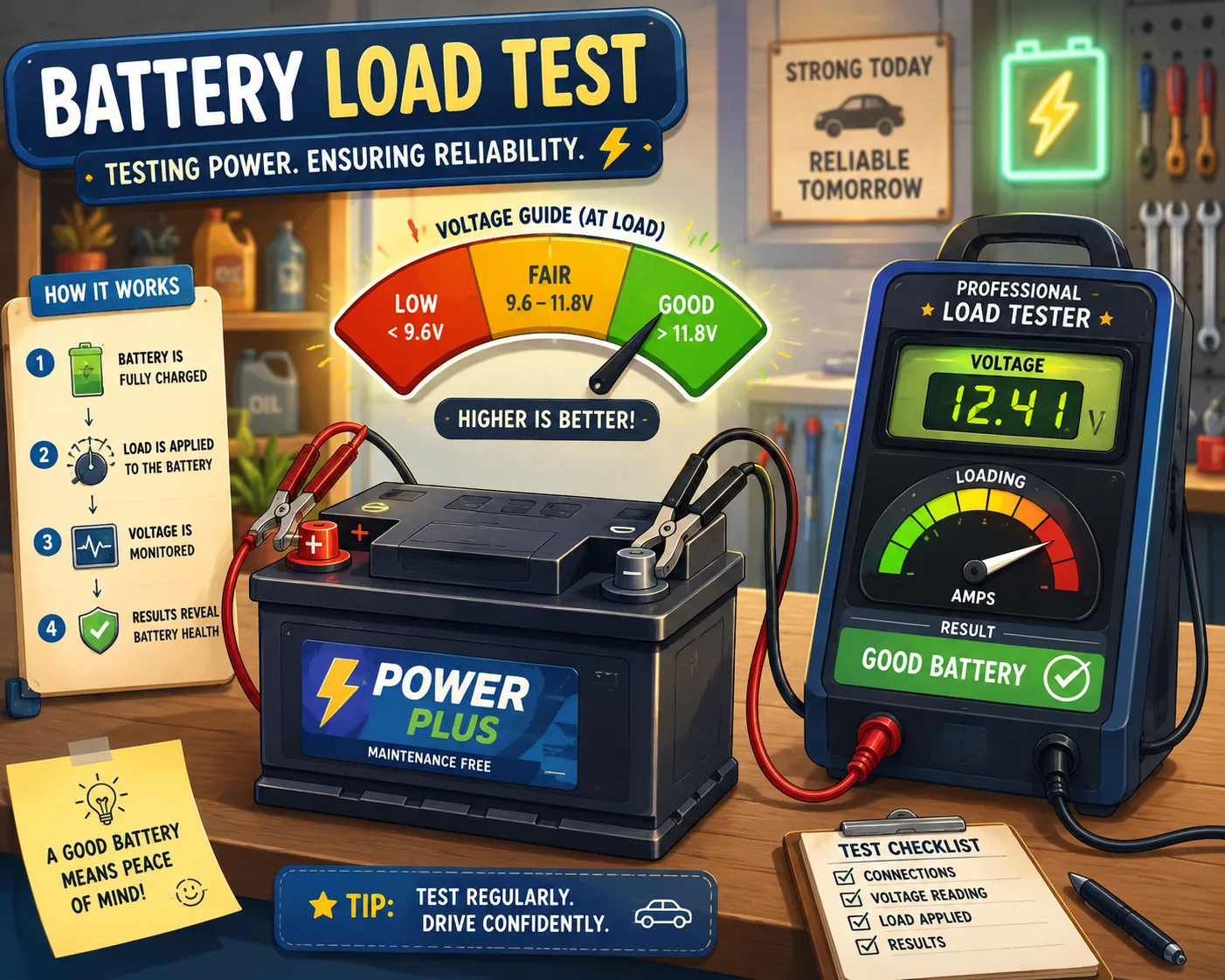
A battery load test intentionally places a controlled electrical demand on the battery while monitoring voltage response. The idea is straightforward: if the battery can maintain acceptable voltage during stress, it passes. If voltage drops excessively, the battery is weak or failing.
In automotive testing, technicians often apply a load equal to half the battery’s Cold Cranking Amp (CCA) rating for approximately 15 seconds. During this period, voltage is carefully observed. Healthy 12V batteries typically remain above 9.6 volts during the test.
The test itself acts like a stress interview for the battery. Instead of asking, “Do you have energy?” it asks, “Can you deliver energy right now under pressure?”
What Happens During a Load Test
The process begins by ensuring the battery is sufficiently charged. Testing a partially discharged battery can produce misleading results because even healthy batteries perform poorly when depleted. Experts recommend stabilizing the battery after charging before testing.
Once prepared, the load tester connects to the battery terminals. The tester applies resistance, forcing the battery to deliver substantial current. During those critical seconds, technicians monitor three main behaviors:
- Voltage drop
- Stability during load
- Recovery after load removal
A healthy battery experiences only moderate voltage reduction and quickly rebounds once the load disappears. Weak batteries show dramatic voltage sag, unstable readings, or slow recovery.
It’s almost like watching someone carry groceries upstairs. A healthy person handles the weight smoothly. Someone exhausted struggles immediately and needs time to recover afterward.
Check This Out: What Is Uf B Wire Used for in Residential Wiring
Common Voltage Thresholds During Testing
Voltage thresholds help determine battery condition. While values vary slightly depending on chemistry and temperature, common guidelines are widely used.
Healthy Voltage Ranges
For standard automotive lead-acid batteries:
| Battery State | Typical Reading |
|---|---|
| Fully charged at rest | ~12.6V |
| Under load (healthy) | Above 9.6V |
| Fast recovery after load | Good condition |
These numbers represent a battery capable of maintaining sufficient power delivery during starting conditions.
Dangerous Voltage Drops
When voltage falls too far under load, serious deterioration likely exists.
| Voltage Under Load | Meaning |
|---|---|
| 9.6V or higher | Healthy |
| 9.0V–9.5V | Weakening |
| Below 9.0V | Failing battery |
Sources from current 2026 testing guides confirm that voltage collapsing below 9.6 volts during a standard automotive load test often signals excessive internal resistance or cell degradation.
Surface Charge vs True Battery Capacity
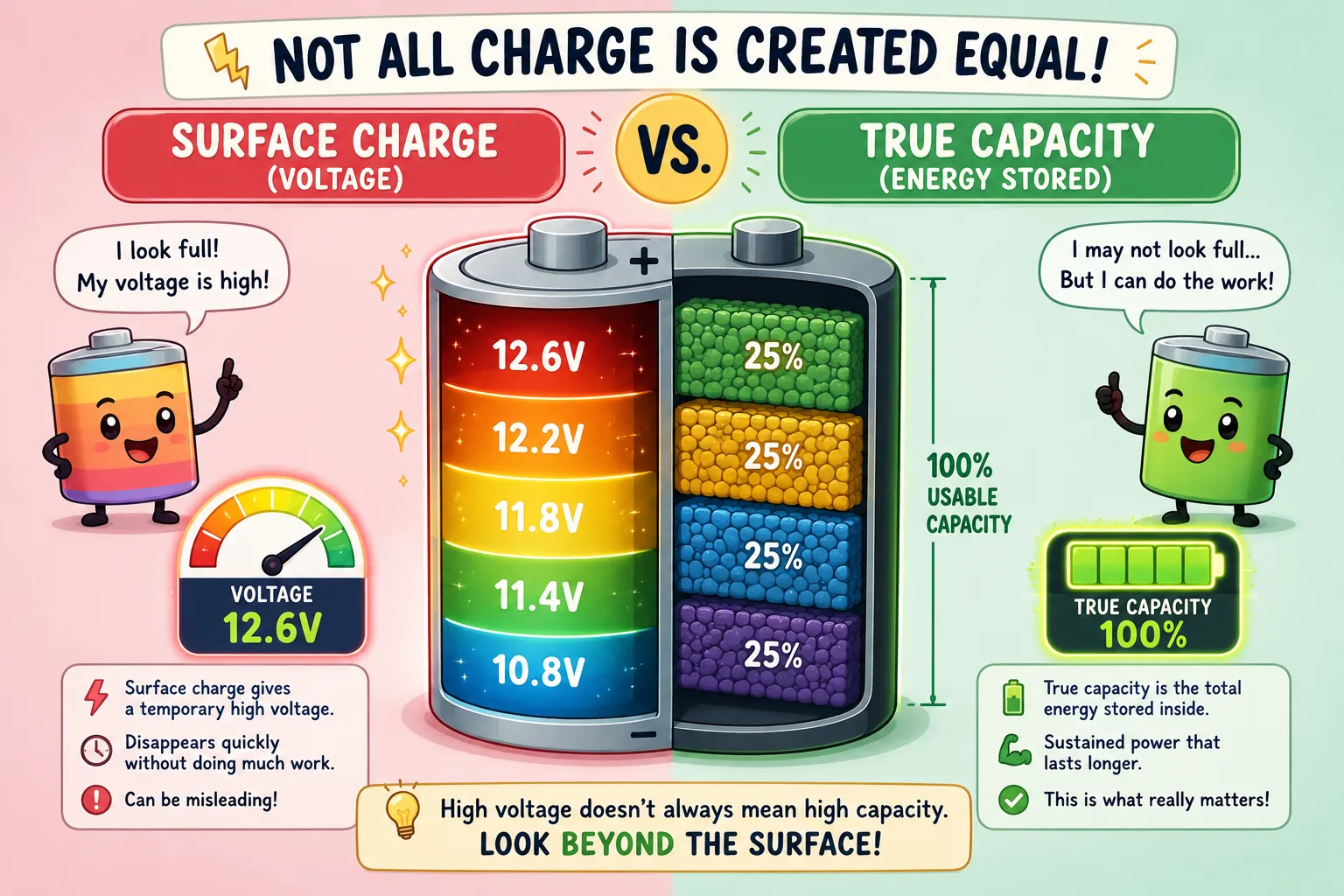
One of the most misunderstood concepts in battery diagnostics is surface charge. This temporary electrical condition tricks countless people into believing a battery is healthier than it actually is.
Surface charge occurs immediately after charging or recent operation. The battery terminals temporarily hold elevated voltage levels that do not accurately reflect actual stored energy or performance capability.
Think of surface charge like foam on top of a freshly poured soda. It looks impressive at first glance, but it doesn’t represent the true volume underneath.
Read More: Why Is Your Battery Charging So Slowly
What Surface Charge Means
When a battery finishes charging, excess electrical activity remains near the plates or cells. This temporarily inflates voltage readings. A battery might display 12.7 or 12.8 volts immediately after charging even if real capacity has deteriorated significantly.
That inflated reading often disappears after:
- Letting the battery rest
- Applying a small load
- Turning on headlights briefly
- Performing a proper load test
Technicians frequently remove surface charge before testing because it masks weakness. Without doing so, a failing battery may falsely appear healthy.
Why Surface Voltage Can Be Misleading
Voltage alone only measures electrical potential. Capacity measures energy storage and delivery capability. These are not the same thing.
A battery with severe sulfation or aging may still achieve normal voltage immediately after charging because surface chemical reactions remain active. Once demand increases, however, internal resistance blocks effective current flow.
Recent diagnostic guides emphasize this exact issue: a battery may show normal voltage at rest yet collapse during actual usage because voltage alone cannot measure true health.
This distinction becomes especially important in:
- Cold weather starting
- RV battery systems
- Solar storage setups
- Marine applications
- Backup power systems
- Electric vehicles
Signs a Battery Is Failing Under Load
A failing battery rarely announces itself politely. Instead, it reveals subtle warning signs that become more obvious under stress.
Some symptoms appear gradually while others emerge suddenly. Understanding these signs helps prevent inconvenient breakdowns and expensive electrical problems.
Voltage Sag and Internal Resistance
Voltage sag is one of the clearest indicators of battery deterioration. As internal resistance rises, the battery struggles to maintain stable voltage during current demand.
<math xmlns=”Vdrop=Vrest−VloadV_{drop}=V_{rest}-V_{load}
Large voltage drops indicate that energy cannot flow efficiently through the battery.
Healthy batteries experience small temporary reductions. Weak batteries experience dramatic collapse. According to modern lithium and lead-acid testing references, high internal resistance directly correlates with severe voltage drop under load.
Drivers often notice this as:
- Dim headlights during startup
- Slow engine cranking
- Electronics resetting during ignition
- Dashboard flickering
- Voltage fluctuations
These symptoms frequently worsen during cold weather because low temperatures further reduce battery efficiency.
Slow Cranking and Recovery Problems
Another common sign involves poor recovery after load removal. Healthy batteries rebound quickly because internal chemistry stabilizes rapidly once demand stops.
Failing batteries recover slowly or remain at depressed voltage levels. This indicates weakened chemical activity, sulfation, or damaged cells.
A weak battery may also crank the engine sluggishly. You can often hear the difference. Instead of a strong, confident starter sound, the engine turns slowly like someone dragging heavy furniture across a carpet.
Many technicians describe battery diagnostics as listening for “energy hesitation.” That hesitation often appears before complete failure.
When Battery Load Testing Should Be Performed
Timing matters when it comes to battery testing. Waiting until complete failure is like waiting for smoke before checking whether your brakes work.
Preventive testing identifies weakness early enough to avoid roadside emergencies.
Our Picks: How Many Volts Are Double a Batteries in Different Setups
Seasonal Testing and Preventive Maintenance
Battery failures spike during temperature extremes. Winter increases oil viscosity and starter demand while reducing battery efficiency. Summer accelerates internal corrosion and electrolyte evaporation.
Because of this, experts commonly recommend testing:
- Before winter
- Before summer road trips
- During annual maintenance
- After long storage periods
Fleet operators and commercial businesses frequently schedule preventive battery testing because downtime costs money. One dead battery can delay deliveries, service calls, or operations.
Modern vehicles are also more sensitive to weak batteries than older cars. Advanced driver assistance systems, infotainment modules, and electronic control units all depend on stable voltage.
Testing Older or Frequently Drained Batteries
Most automotive batteries begin showing performance decline after three to five years depending on usage, climate, and maintenance habits.
Frequent deep discharges also accelerate wear. Batteries in vehicles with heavy accessory usage, stop-and-go driving, or short trips often deteriorate faster because charging cycles remain incomplete.
Testing becomes especially important if:
- The battery is older than three years
- The vehicle struggles during startup
- Electronics behave unpredictably
- The battery has been deeply discharged
- The battery sat unused for long periods
Recent research into battery aging continues to confirm that repeated stress and increasing resistance strongly affect long-term performance.

Related Articles: How Long Should a Car Battery Last Without Driving
Tools Commonly Used for Battery Testing
Battery testing tools range from simple handheld devices to sophisticated computerized analyzers. Each serves a slightly different purpose.
Carbon Pile Testers
The traditional carbon pile tester remains one of the most respected load-testing tools. It creates adjustable resistance that places heavy demand on the battery while technicians monitor voltage response.
These testers generate heat because they physically dissipate electrical energy during testing. Many experienced mechanics still trust them because they simulate real-world load conditions very effectively.
Older analog carbon pile testers may look primitive compared to digital tools, but they remain highly effective for identifying voltage collapse.
Electronic Conductance Testers
Modern conductance testers analyze battery condition electronically without applying extremely heavy loads. They estimate battery health by measuring conductance and internal resistance.
Advantages include:
- Faster testing
- Less heat generation
- Safer operation
- Easier diagnostics
- Digital reporting
Many automotive shops now prefer conductance testers because they quickly evaluate modern AGM and lithium battery systems.
Digital Multimeters and Load Simulators
Digital multimeters remain useful for measuring resting voltage, charging system output, and basic diagnostics. Combined with external loads or specialized testers, they become even more valuable.
Some advanced systems also use pulse testing, resistance measurements, or computerized battery management analytics to evaluate condition.
Battery diagnostics today increasingly combine:
- Voltage monitoring
- Conductance testing
- Capacity estimation
- Internal resistance analysis
- Load simulation
This layered approach improves accuracy dramatically.
Why Batteries Sometimes Pass Voltage Tests but Still Fail
This question confuses many vehicle owners: how can a battery show “good voltage” and still fail?
The answer lies inside the battery itself.
Internal Resistance Problems
As batteries age, internal resistance increases. Chemical pathways degrade, sulfation accumulates, and conductive efficiency decreases.
The battery still stores some electrical potential, which explains why voltage appears normal. However, resistance prevents rapid energy delivery when heavy current is required.
That’s why batteries can:
- Power dashboard lights
- Run small electronics
- Show normal voltage
…but still fail to crank an engine.
Recent discussions among technicians and battery specialists repeatedly highlight internal resistance as the hidden culprit behind misleading voltage readings.
Sulfation and Aging Effects
Lead-acid batteries commonly suffer from sulfation, where lead sulfate crystals harden on battery plates. This reduces active surface area and restricts chemical reactions.
Other aging effects include:
- Corrosion
- Electrolyte degradation
- Plate shedding
- Cell imbalance
- Heat damage
Lithium batteries experience different aging mechanisms, but the principle remains similar: aging increases resistance and reduces effective power delivery.
That’s why professional diagnostics increasingly focus on performance under load instead of simple voltage readings.

Conclusion
Battery load testing reveals the truth hidden behind surface voltage. A battery may appear fully charged while secretly lacking the strength needed to perform under stress. By applying controlled demand and monitoring voltage behavior, load testing exposes weaknesses that ordinary multimeter readings cannot detect.
The process matters because modern vehicles and electrical systems depend on reliable energy delivery. Internal resistance, sulfation, aging, and degraded cells often remain invisible until heavy current demand exposes them. This is why batteries sometimes pass simple voltage checks yet still fail during engine startup or high-power operation.
Understanding the difference between resting voltage, surface charge, and true capacity helps avoid misdiagnosis and unexpected breakdowns. Whether using traditional carbon pile testers or advanced digital conductance analyzers, the goal remains the same: determine whether the battery can deliver real-world performance when it matters most.
Routine load testing is one of the smartest preventive maintenance practices available. It saves time, reduces electrical failures, and provides a far more accurate picture of battery health than voltage readings alone ever could.
See Also: What Does MCA Mean on a Battery
FAQs
1. What is the main purpose of a battery load test?
The main purpose is to determine whether a battery can maintain adequate voltage while supplying current under real operating conditions. It measures true performance instead of just resting voltage.
2. What voltage should a healthy 12V battery maintain during a load test?
Most healthy 12V automotive batteries should remain above approximately 9.6 volts during a standard 15-second load test.
3. Can a battery show 12.6 volts and still be bad?
Yes. A battery can display normal voltage while suffering from high internal resistance or reduced capacity. Under load, voltage may collapse rapidly even though resting voltage appears healthy.
4. How often should battery load testing be performed?
Testing is commonly recommended annually, before winter, before long trips, or whenever symptoms like slow cranking or electrical instability appear.
5. What causes voltage drop during a load test?
Voltage drop occurs because current demand exposes internal resistance and chemical limitations inside the battery. Excessive voltage sag usually indicates aging, sulfation, or deteriorated cells.

Colt Marlowe is a 29-year-old American content writer based in Boise, Idaho. He specializes in technology, digital tools, and online business topics, combining years of research with practical experience to produce clear, trustworthy articles. As a contributor to wirelogic.online, he focuses on creating well-researched, reader-friendly content that emphasizes accuracy, transparency, and long-term value for audiences seeking reliable information.