
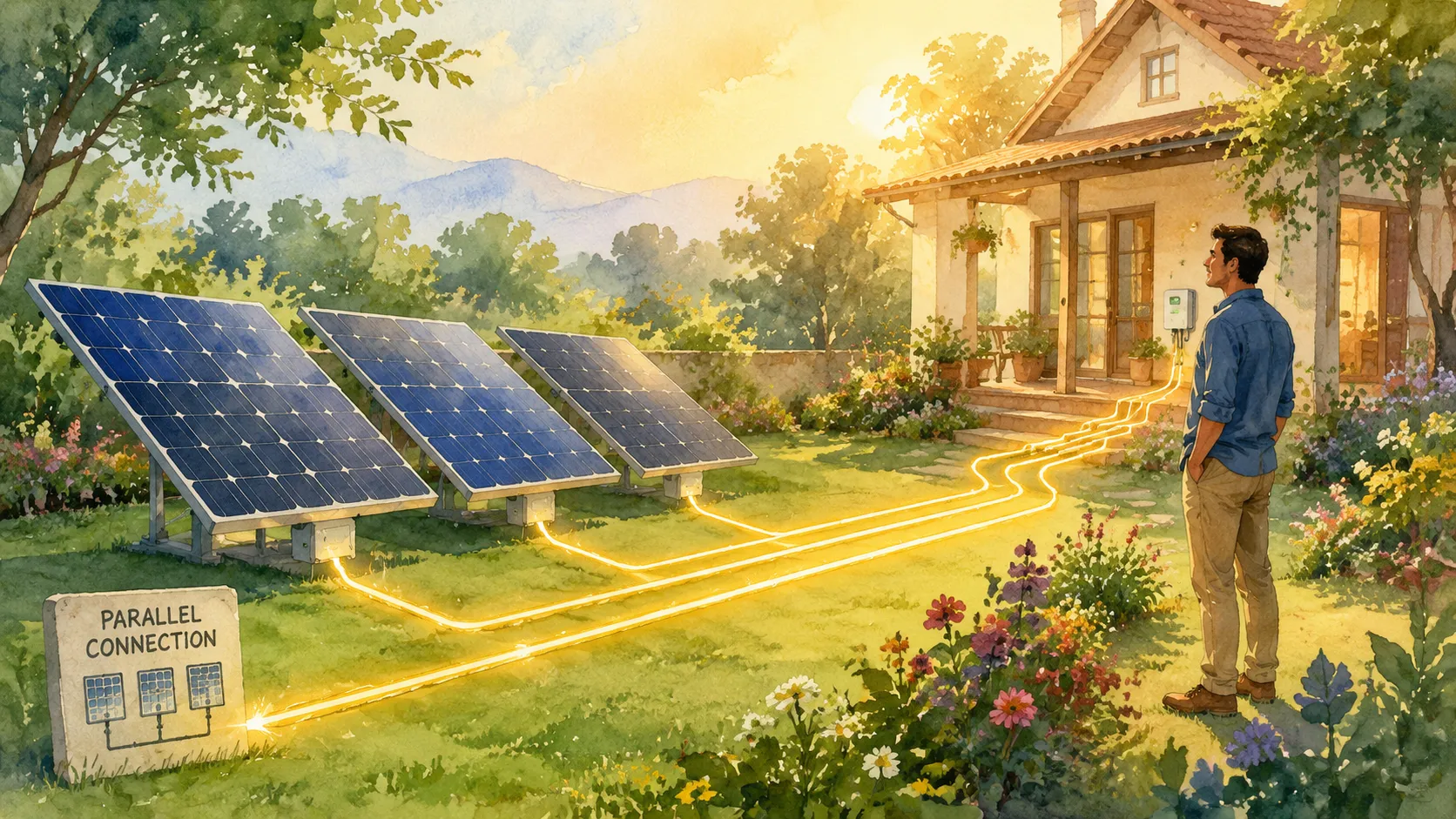
Solar energy has become one of the fastest-growing renewable energy solutions in the world, and the technology behind it keeps improving every year. Recent industry reports show that modern residential solar panels now regularly exceed 22% efficiency, while advanced commercial modules are pushing beyond 25% efficiency in 2026. As more homeowners, RV owners, and off-grid enthusiasts install solar systems, one question keeps popping up: how should the panels actually be connected? That is where parallel wiring enters the picture.
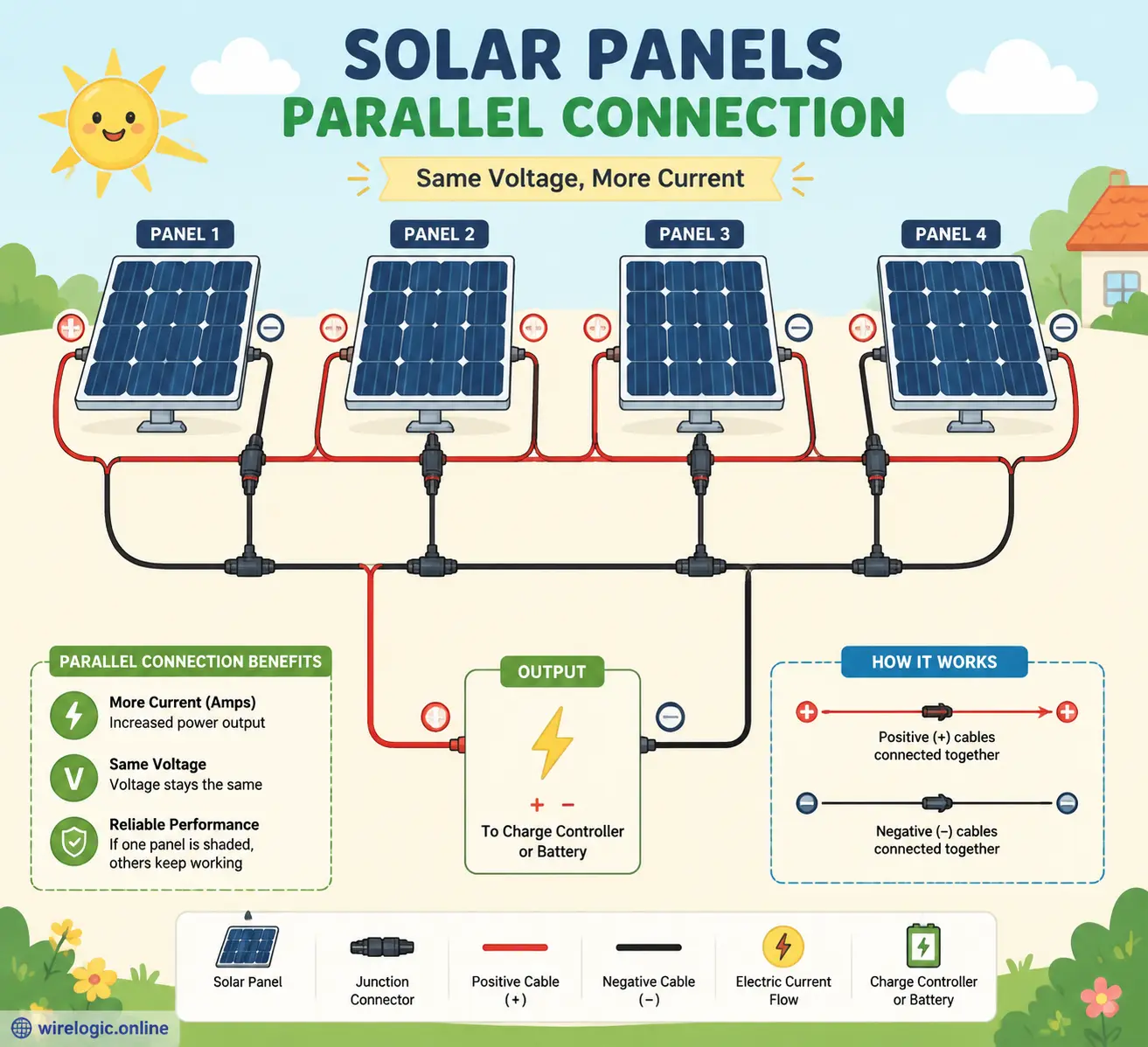
When solar panels are connected in parallel, all the positive terminals are linked together, and all the negative terminals are connected together as well. This setup allows the system to maintain the same voltage while increasing the total current output. Think of it like adding more lanes to a highway. The speed limit stays the same, but more cars can travel at once. In solar systems, voltage remains steady while amperage increases, giving the system more overall power capacity.
Parallel wiring is especially common in smaller off-grid systems, camper vans, marine applications, and residential backup setups. People prefer this method because it offers flexibility and better shade tolerance compared to series wiring. If one panel becomes shaded or dirty, the other panels continue producing energy more independently. That is a huge advantage in real-world conditions where sunlight is rarely perfect all day long.
Another reason parallel systems are popular is safety and compatibility. Many charge controllers and battery systems are designed around specific voltage limits. By keeping voltage stable, users can expand their solar arrays without exceeding the safe operating range of the controller. This makes future upgrades easier and often less expensive.
Why Parallel Wiring Is Used in Solar Installations
Parallel solar wiring is not just a random installation method. It solves specific problems that many solar users face daily. One of the biggest reasons people choose parallel wiring is its ability to maintain system stability even when environmental conditions are inconsistent. Imagine a rooftop where one side gets morning shade from a tree or chimney. In a series system, that shaded panel can reduce the performance of the entire string. In a parallel setup, the other panels continue producing power much more effectively.
This characteristic makes parallel wiring extremely attractive for RVs, boats, cabins, and urban homes where shade patterns constantly change. It is like having a basketball team where one tired player does not stop the rest of the team from scoring. Each panel contributes individually to the total output. That independence improves reliability and helps maintain better energy production during cloudy days or partial shading situations.
Another major benefit involves system expansion. Suppose someone starts with two solar panels and later wants to add two more. With a parallel system, expansion is usually straightforward because the voltage remains unchanged. The installer mainly focuses on handling the increased current safely. This flexibility makes parallel wiring beginner-friendly and highly adaptable for growing energy needs.
Modern solar technology has also made parallel wiring more efficient than ever. Industry data from 2026 shows that premium solar modules now operate at significantly higher efficiencies than panels produced just five years ago. Higher panel efficiency means users can generate more current from fewer panels, making parallel systems even more practical for compact installations.
Voltage and Current Changes in Parallel Connections
One of the most important concepts in solar wiring is understanding how voltage and current behave in parallel circuits. Many beginners confuse these electrical terms, but once you visualize the process, it becomes surprisingly simple. In a parallel connection, voltage stays the same while current adds together across all panels.
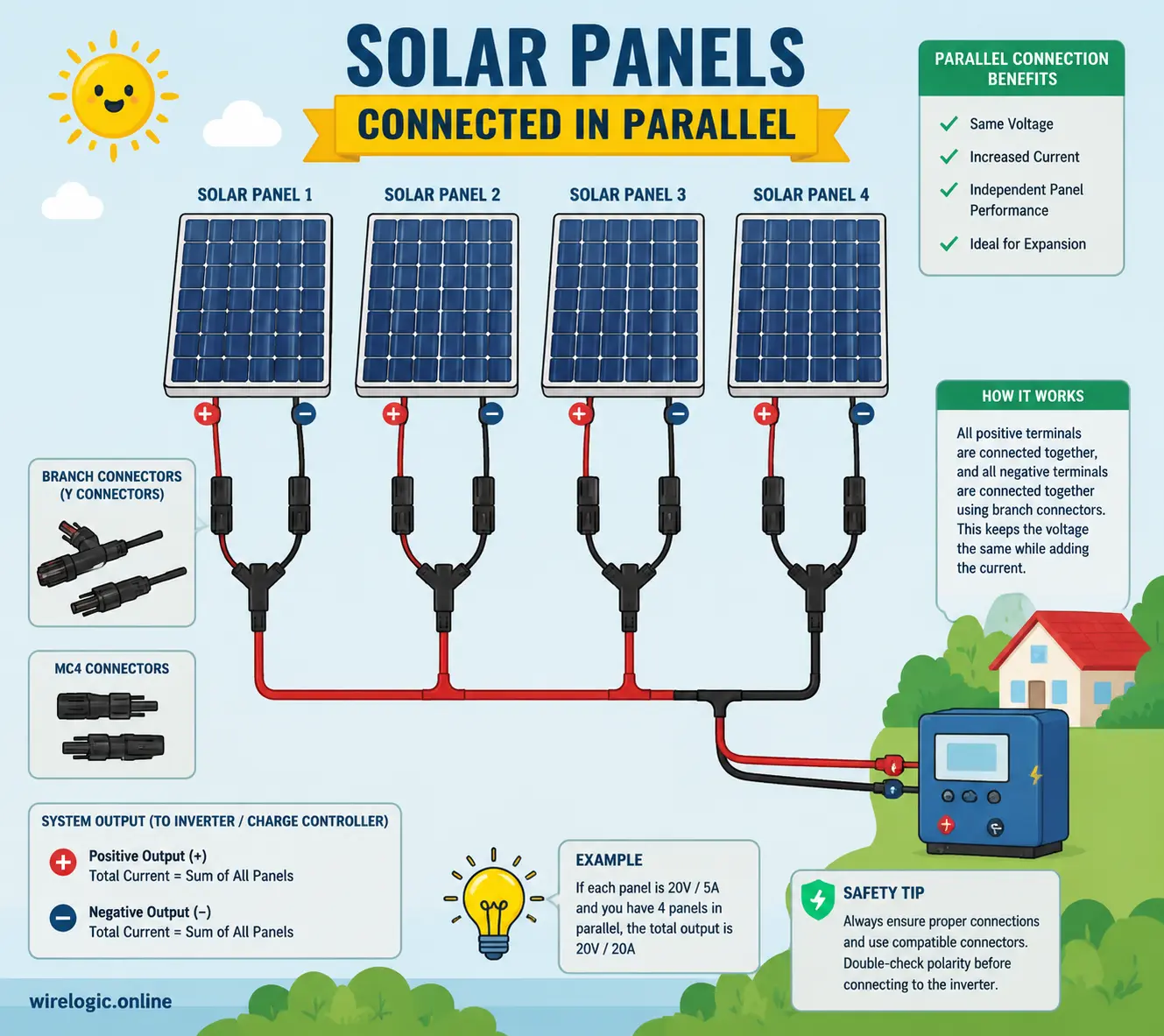
For example, imagine two 12-volt solar panels, each producing 10 amps. When connected in parallel, the voltage remains 12 volts, but the total current becomes 20 amps. That increased current translates into more total wattage available for charging batteries or powering devices.
<math xmlns="
This formula explains why power increases in parallel systems. Since voltage stays constant and current rises, the total wattage increases proportionally. That is why many off-grid battery systems rely heavily on parallel configurations. They can generate higher charging currents without increasing system voltage beyond safe limits.
Here is a simple comparison table:
| Connection Type | Voltage | Current | Best Use |
|---|---|---|---|
| Series | Adds Together | Remains Same | High-voltage systems |
| Parallel | Remains Same | Adds Together | Battery charging and shade-prone systems |
Understanding this electrical behavior is critical because it directly affects cable sizing, fuse requirements, and charge controller compatibility. Higher current means thicker wires are usually required to reduce energy losses and prevent overheating. Ignoring this detail is one of the most common installation mistakes beginners make.
Tools and Components Needed for Parallel Wiring
Connecting solar panels in parallel requires more than just plugging wires together. A safe and efficient installation depends on using the proper components. Fortunately, modern solar equipment is designed to simplify the process, even for DIY users.
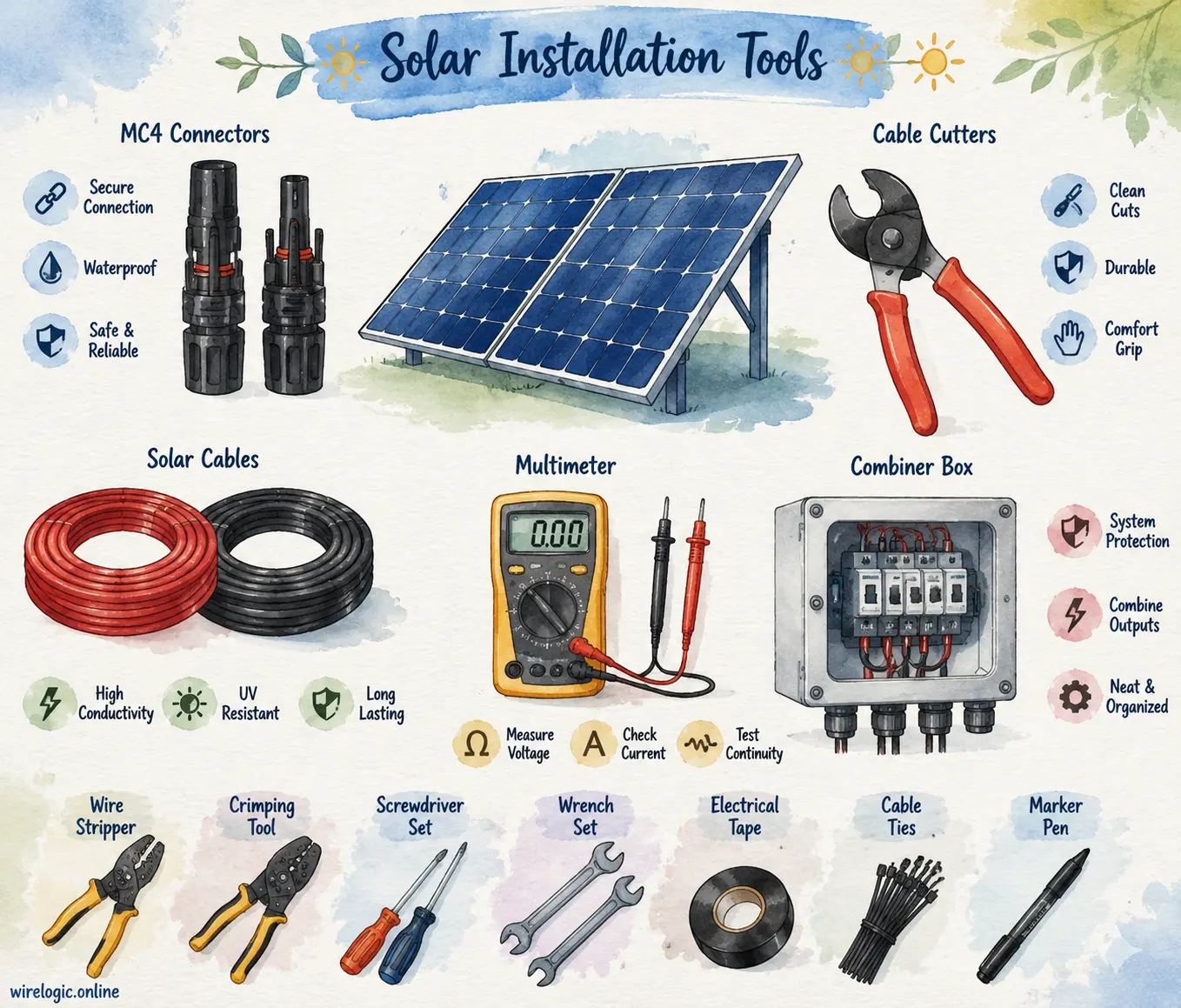
One of the most essential tools is the MC4 connector. These weatherproof connectors have become the standard for modern solar panels because they create secure and waterproof electrical connections. MC4 branch adapters allow multiple panels to combine their positive and negative outputs into a single pair of wires leading toward the charge controller.
Without these adapters, parallel wiring would become messy and unreliable. Imagine trying to merge several garden hoses into one line without proper fittings. Water would leak everywhere. Electrical systems behave similarly. Loose or poor-quality connections increase resistance, generate heat, and reduce efficiency.
Another important component is the combiner box. Larger solar arrays often use combiner boxes to organize multiple panel strings and provide fuse protection. Fuses are critical because they protect panels and wiring from excessive current during faults or short circuits. If one branch develops a problem, the fuse isolates the issue before serious damage occurs.
Safety equipment matters just as much as the electrical hardware. Installers should use insulated gloves, multimeters, proper cable crimpers, and circuit breakers rated for DC applications. Solar power may look harmless compared to household AC electricity, but DC arcs can be extremely dangerous and difficult to extinguish.
Step-by-Step Guide to Connecting Solar Panels in Parallel
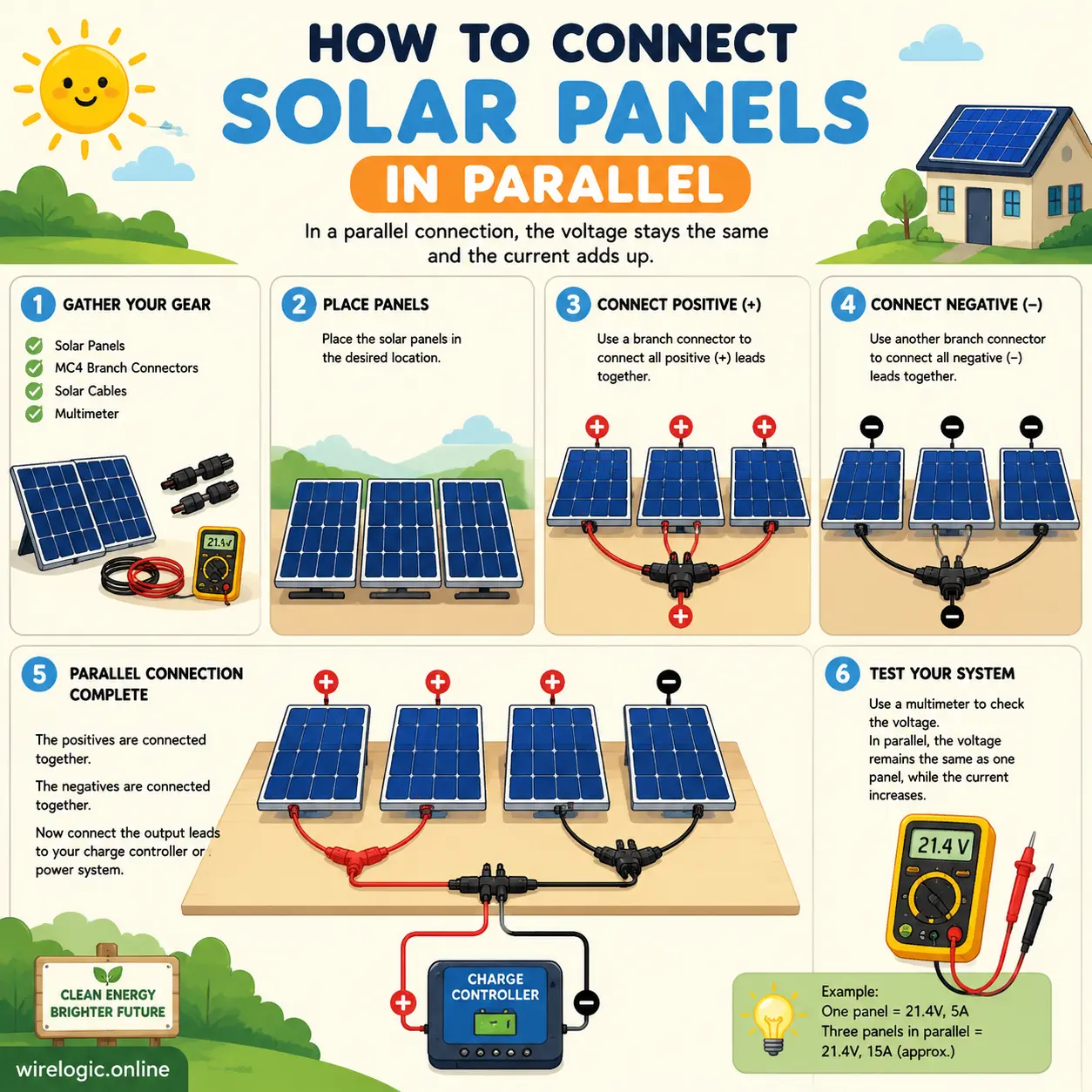
Installing solar panels in parallel becomes much easier when broken into clear steps. The first task is ensuring all panels have compatible electrical ratings. Ideally, the panels should share similar voltage characteristics to avoid performance losses. Mixing mismatched panels can create imbalance issues where stronger panels compensate for weaker ones inefficiently.
Before making any connections, place the panels in a safe location away from direct heavy loads or accidental contact. Even under moderate sunlight, solar panels generate live electricity immediately. That means safety precautions should never be skipped. Disconnect charge controllers and battery banks during installation whenever possible.
The next step involves connecting the positive terminals together using MC4 branch connectors. After that, connect all negative terminals together using matching branch adapters. This creates the parallel configuration where current combines while voltage remains unchanged.
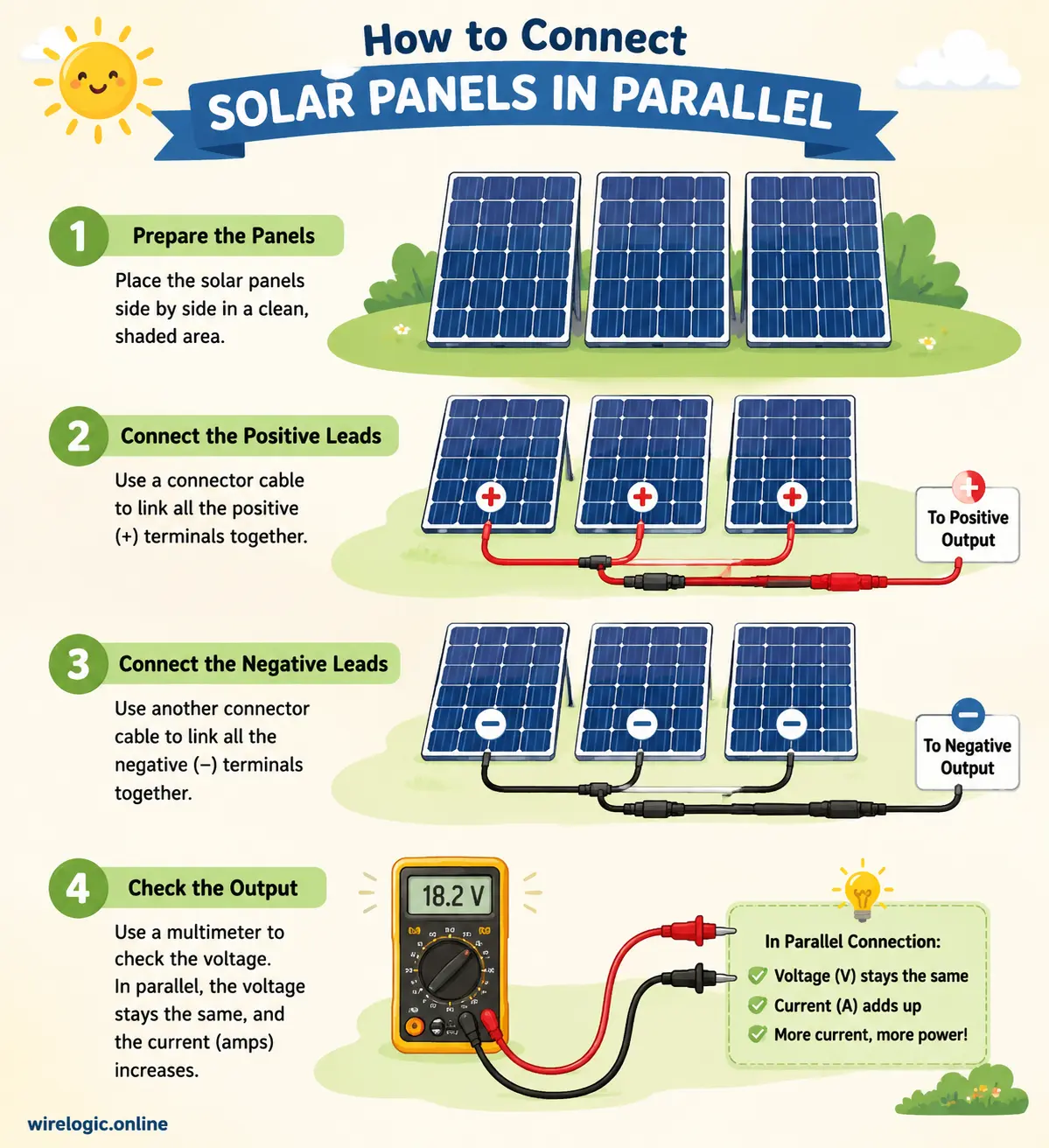
Once the panel outputs are combined, run the main positive and negative cables to the charge controller. The controller regulates energy flow into the batteries and prevents overcharging. Modern MPPT charge controllers are especially effective because they maximize energy harvesting under changing sunlight conditions.
After completing the wiring, use a multimeter to test system voltage before connecting batteries or inverters. If two 12-volt panels are connected properly in parallel, the voltage should still measure close to 12 volts under sunlight. The amperage, however, should increase substantially.
Matching Solar Panels for Better Performance
One of the biggest mistakes people make in solar installations is mixing panels with incompatible specifications. It might seem harmless to combine different brands or wattages, but mismatched panels can dramatically reduce system efficiency. Solar panels work best when their voltage and current characteristics align closely.
Think of it like a relay race where one runner moves much slower than the others. The entire team performance suffers because everyone must adapt to the slowest pace. In solar systems, the mismatch creates energy losses and instability that reduce overall output.
The most important specification to match is voltage. Parallel systems depend on maintaining equal voltage across all panels. If one panel operates at a significantly different voltage, it may contribute less power or even absorb current from stronger panels under certain conditions.
Current differences are slightly less problematic in parallel systems than in series systems, but large mismatches can still reduce efficiency. Installers usually recommend using panels from the same manufacturer and production batch whenever possible. This ensures similar electrical characteristics and predictable behavior.
Recent advances in solar manufacturing have improved panel consistency dramatically. Modern TOPCon and HJT solar technologies now achieve efficiency ranges between 21.5% and 25.5% depending on the module type. These improvements help reduce long-term degradation and maintain more stable performance over time.
Preventing Reverse Current Problems
Reverse current is one of the hidden dangers in poorly designed parallel solar systems. This occurs when electricity flows backward from stronger panels or batteries into weaker or shaded panels. Over time, reverse current can cause overheating, reduced lifespan, and even permanent panel damage.
A good way to visualize reverse current is imagining water flowing backward through a pipe because pressure on one side becomes stronger than the other. Electricity naturally follows similar principles. When one panel produces less voltage due to shade or malfunction, neighboring panels may push current backward through it.
Blocking diodes help prevent this issue by allowing current to flow in only one direction. Many modern solar panels already include bypass diodes internally, but additional protection may still be necessary in larger systems. Fuses also provide essential protection by interrupting excessive current flow before wiring damage occurs.
Proper wire sizing is equally important. Undersized cables create resistance that wastes power as heat. In high-current parallel systems, voltage drop becomes a serious concern if cable thickness is inadequate. This is why professional installers calculate wire gauge carefully based on system current and cable length.
Routine inspections also play a major role in preventing electrical issues. Loose connectors, corrosion, moisture intrusion, and damaged insulation can all contribute to reverse current problems or power losses. Solar systems operate outdoors year-round, so environmental wear should never be underestimated.
How Parallel Wiring Performs Under Shade
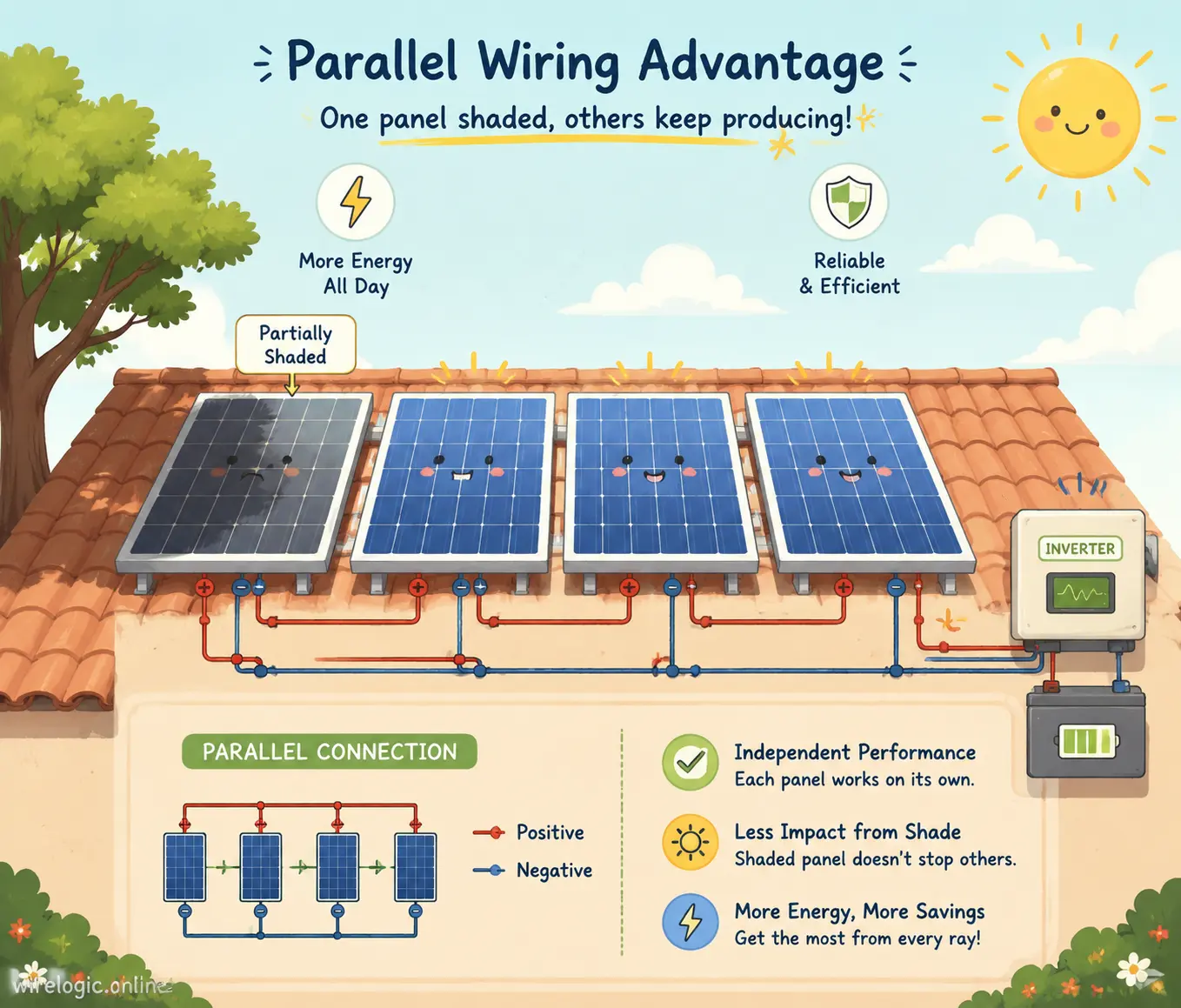
Shade is one of the biggest enemies of solar energy production. A single tree branch or nearby building can significantly affect panel performance. This is where parallel wiring demonstrates one of its strongest advantages compared to series configurations.
In a series circuit, current flows through all panels in a single path. If one panel becomes shaded, the current through the entire string drops dramatically. It is like a traffic jam caused by one blocked lane. Everything behind it slows down.
Parallel wiring behaves differently because each panel contributes more independently. If one panel experiences shade, the other panels continue delivering near-normal output. That means total energy production drops less severely under partial shading conditions.
This advantage becomes especially important for residential rooftops where sunlight changes throughout the day. Chimneys, antennas, nearby trees, and seasonal sun angles constantly create shifting shade patterns. Parallel systems handle these conditions far better than many people realize.
Researchers and solar installers continue improving shade performance using smarter electronics and higher-efficiency panel technologies. Recent developments in advanced solar cells are pushing module efficiencies beyond 25%, helping systems generate more power even under imperfect conditions. While no solar setup completely eliminates shade losses, parallel wiring offers a practical way to minimize them.
Testing and Troubleshooting the Solar System
Once the installation is complete, testing becomes critical. Many solar problems remain invisible until performance starts dropping unexpectedly. A proper testing routine helps identify issues early before they become expensive failures.
The first step is measuring open-circuit voltage using a multimeter. In a parallel system, the measured voltage should closely match the voltage rating of a single panel. If the voltage appears unusually low, there may be a wiring problem, faulty connector, or damaged panel.
Current testing is equally important. Because parallel systems increase amperage, installers should verify that the total current output matches expected values under sunlight conditions. Large discrepancies often indicate shading problems, loose MC4 connectors, or panel mismatches.
Thermal inspections can also reveal hidden problems. Hot spots on connectors or cables usually indicate resistance buildup caused by poor connections. Over time, these hot spots can melt insulation and create fire hazards. That is why professional installers frequently use infrared cameras during maintenance checks.
One of the most overlooked mistakes involves poor cable management. Tangled or unsupported cables can suffer abrasion from wind movement or sharp edges. Water exposure combined with damaged insulation creates serious long-term reliability issues.
Another common problem is ignoring system expansion planning. Many DIY users initially install small systems without considering future upgrades. Later, when additional panels are added, the original wiring may become undersized for the higher current load. Planning for future expansion from the beginning saves money and prevents major rewiring later.
Conclusion
Connecting solar panels in parallel is one of the most practical and flexible ways to build a reliable solar energy system. By keeping voltage stable while increasing current, parallel wiring supports efficient battery charging and performs exceptionally well under partial shading conditions. This makes it ideal for RVs, cabins, residential rooftops, boats, and many off-grid applications.
The success of a parallel solar setup depends heavily on proper planning. Matching panel specifications, using quality MC4 connectors, installing proper fuses, and selecting correct wire sizes all contribute to long-term reliability and performance. Even small installation mistakes can reduce energy output significantly over time.
Modern solar technology continues advancing rapidly. Industry data from 2026 shows residential panel efficiencies now commonly exceed 22%, while cutting-edge commercial modules push beyond 25%. These improvements make solar energy more accessible and powerful than ever before.
A well-designed parallel solar system does more than generate electricity. It provides energy independence, resilience during outages, and long-term savings that continue for decades. Whether powering a home, RV, or off-grid cabin, understanding how parallel wiring works gives users the confidence to build safer and more efficient solar systems.
FAQs
1. Can solar panels with different wattages be connected in parallel?
Yes, but it is not ideal. Panels with different wattages can work together if their voltage ratings are similar. Large mismatches may reduce efficiency and create uneven performance.
2. Does parallel wiring increase solar panel voltage?
No. In a parallel connection, voltage remains the same while current increases. This is one of the defining characteristics of parallel solar wiring.
3. Are MC4 connectors necessary for parallel solar systems?
Yes, MC4 connectors and branch adapters provide secure, waterproof, and reliable electrical connections. They are considered industry standard for modern solar installations.
4. Why does parallel wiring handle shade better?
Each panel operates more independently in a parallel system. If one panel becomes shaded, the others continue producing power with less impact on overall output.
5. What is the biggest mistake when wiring solar panels in parallel?
One of the most common mistakes is using undersized wires. Higher current levels in parallel systems require thicker cables to prevent voltage drop, overheating, and energy loss.

Colt Marlowe is a 29-year-old American content writer based in Boise, Idaho. He specializes in technology, digital tools, and online business topics, combining years of research with practical experience to produce clear, trustworthy articles. As a contributor to wirelogic.online, he focuses on creating well-researched, reader-friendly content that emphasizes accuracy, transparency, and long-term value for audiences seeking reliable information.