
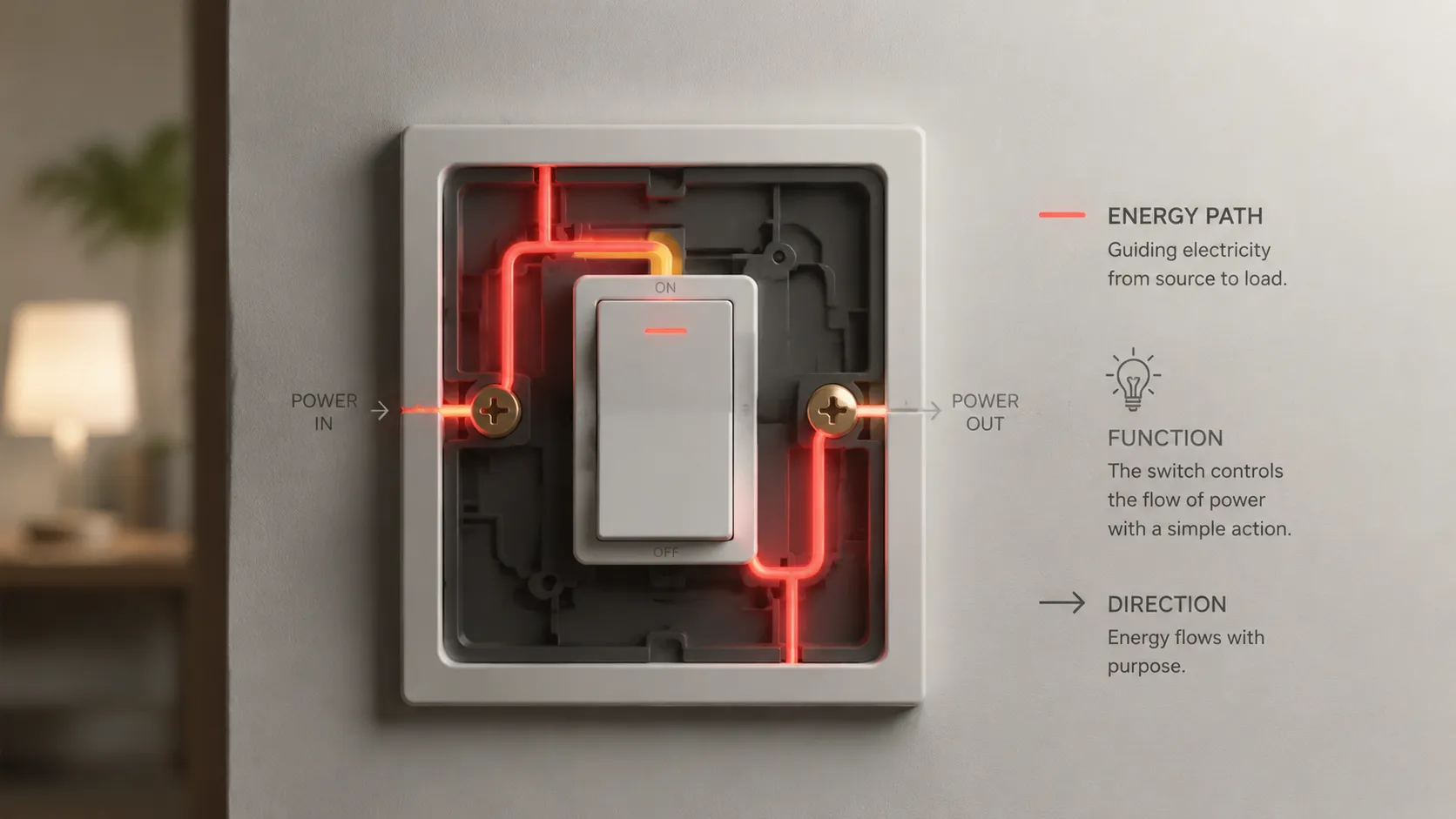
Electricity has a funny way of looking simple until you open a switch box and discover a jungle of wires staring back at you. Most homeowners expect to see a black wire, a white wire, and maybe a ground wire. Then suddenly there’s a red wire connected to the switch, and confusion kicks in immediately. Is it dangerous? Is it always hot? Does it mean the switch is wired incorrectly? Those questions are incredibly common, especially during DIY home improvement projects.
The truth is that a red wire in a light switch usually serves a very specific purpose, but that purpose can vary depending on the circuit design. In some homes, the red wire acts as a traveler wire in a three-way switch setup. In others, it carries constant power or switched power to another fixture. Sometimes it’s tied into ceiling fan systems or split receptacles. The tricky part is this: wire colors are conventions, not guarantees. That means blindly trusting wire colors can lead to dangerous mistakes.
Electrical experts repeatedly warn against identifying conductors by color alone because older homes, renovations, and nonstandard installations can completely change what a wire actually does. According to multiple recent electrical safety discussions and residential wiring references, improperly identified conductors remain one of the biggest causes of DIY electrical accidents.
Before touching any electrical wiring, it’s essential to understand what the red wire may represent and how to identify it properly. This guide breaks down the most common uses of red wires in light switch circuits, explains how traveler systems work, and shows safe ways to determine what each wire is actually doing inside the box.
Why Red Wires Confuse So Many Homeowners
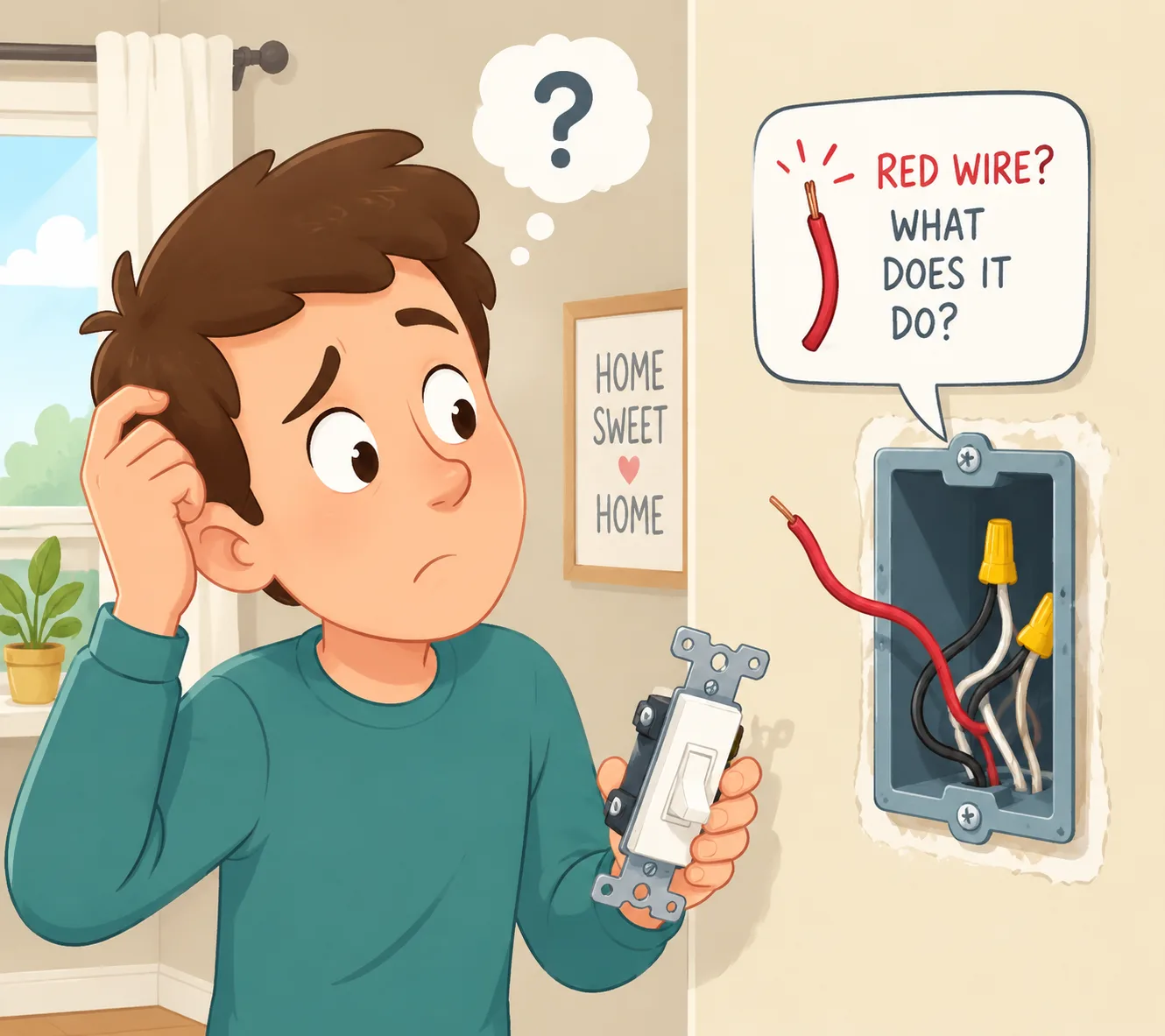
If you’ve ever removed a light switch cover plate expecting a quick five-minute replacement and then suddenly spotted a mysterious red wire, you’re definitely not alone. Red wires tend to create confusion because they don’t appear in every switch box. In a simple single-pole switch setup, you’ll usually only see a black hot wire, a white neutral wire, and a bare copper ground. Once a red wire enters the picture, the circuit is often more complicated than a basic on-and-off switch.
A huge part of the confusion comes from the fact that people naturally assume wire colors always mean the same thing. It feels logical, right? Black equals hot, white equals neutral, green equals ground, and red must always have one specific job. Real-world electrical wiring doesn’t always behave that neatly. Homes built decades apart can follow different wiring practices, and renovations often introduce mixed wiring methods into the same house. Some electricians even repurpose conductors depending on circuit requirements, which can completely change what a wire color traditionally represents.
Recent electrical wiring references explain that red wires are commonly used as secondary hot conductors or traveler wires in multi-switch systems. But that doesn’t mean every red wire serves the same role. In one room, the red wire may control a ceiling fan light kit. In another room, it could be delivering constant power to another switch or outlet downstream.
Think of electrical wire colors like traffic signs in another country. Most of the time, they guide you correctly, but you should still verify where you’re going instead of blindly assuming every sign means exactly what you expect. That’s why professional electricians rely on testers and circuit tracing tools instead of simply trusting insulation colors.
The moment you understand that wire colors are guidelines rather than absolute rules, electrical systems start making a lot more sense. That mindset alone can prevent dangerous assumptions and costly mistakes during DIY electrical work.
The Typical Purpose of a Red Electrical Wire
In residential electrical systems, a red wire is usually considered a secondary hot conductor. Unlike white wires, which are generally neutrals, red wires almost always carry electrical current in some form. The exact job depends on the circuit configuration, but one thing is consistent: red wires should be treated as potentially energized until proven otherwise with proper testing equipment.
In many homes, the red wire acts as a switched hot conductor. Imagine a ceiling fan with separate controls for the fan motor and the light fixture. The black wire may power the fan continuously, while the red wire controls the light independently through a wall switch. This arrangement allows homeowners to operate the fan and light separately without needing pull chains. It’s one of the most common modern residential uses for red conductors.
Another typical application involves three-way switches, where one light can be controlled from two separate locations. Hallways, staircases, and large rooms commonly use this design. In these systems, the red wire often works as a traveler conductor carrying current between switches. Recent electrical wiring guides consistently identify red wires as frequent traveler wires in multi-location switching systems.
There’s also the issue of 240-volt circuits. In those setups, red wires frequently serve as the second hot conductor alongside a black wire. Dryers, ranges, water heaters, and HVAC systems often use this arrangement. That means a red wire in your home isn’t automatically tied to lighting circuits at all.
Here’s a quick comparison of common wire color functions in residential wiring:
| Wire Color | Typical Function | Common Location |
|---|---|---|
| Black | Primary hot wire | Switches, outlets, fixtures |
| Red | Secondary hot or traveler | Three-way switches, fans, 240V circuits |
| White | Neutral conductor | Return path to panel |
| Green/Bare Copper | Ground wire | Safety grounding |
The important takeaway is that a red wire almost never appears “by accident.” Its presence usually signals a more advanced wiring configuration that deserves careful attention before any modifications are made.

Where Red Wires Commonly Appear in Switch Circuits
One of the easiest ways to understand red wires is by looking at the situations where they commonly appear. Once you recognize the patterns, opening a switch box becomes a lot less intimidating. You begin spotting clues about the circuit design before even touching a tester.
Ceiling fan installations are one of the biggest examples. Many fan/light combos use a three-conductor cable containing black, red, white, and ground wires. The black conductor often powers the fan motor continuously or through one switch, while the red conductor independently controls the light fixture. This setup creates separate wall-switch functionality, which most homeowners prefer because it feels more convenient and modern.
Another common location is switched outlets. In some rooms, especially older bedrooms and living rooms, one half of a wall outlet may be controlled by a light switch while the other half remains constantly energized. The red wire frequently acts as the switched conductor in these split receptacle systems. This design became popular before built-in ceiling lighting became standard in many homes.
Three-way and four-way switch systems are probably the most recognizable examples of red-wire usage. Hallways and stairwells often require lighting control from multiple locations. To make that happen, electricity must travel between switches using dedicated conductors called travelers. Red wires are commonly chosen for this role because they visually distinguish traveler circuits from standard hot wires.
Some electricians also use red wires to carry constant power between multiple switches in the same electrical box. For example, one incoming hot wire might feed several switches controlling different fixtures. Instead of overcrowding one terminal screw, electricians often splice conductors together using pigtails and red jumpers to distribute power safely.
That’s why opening a switch box can feel like solving a puzzle. A red wire might represent switched power, constant power, traveler functionality, or a secondary hot leg. Context matters enormously. The number of switches, cable types, fixture arrangement, and testing results all help reveal the wire’s true purpose.
Three Way Switches and Traveler Wire Functions
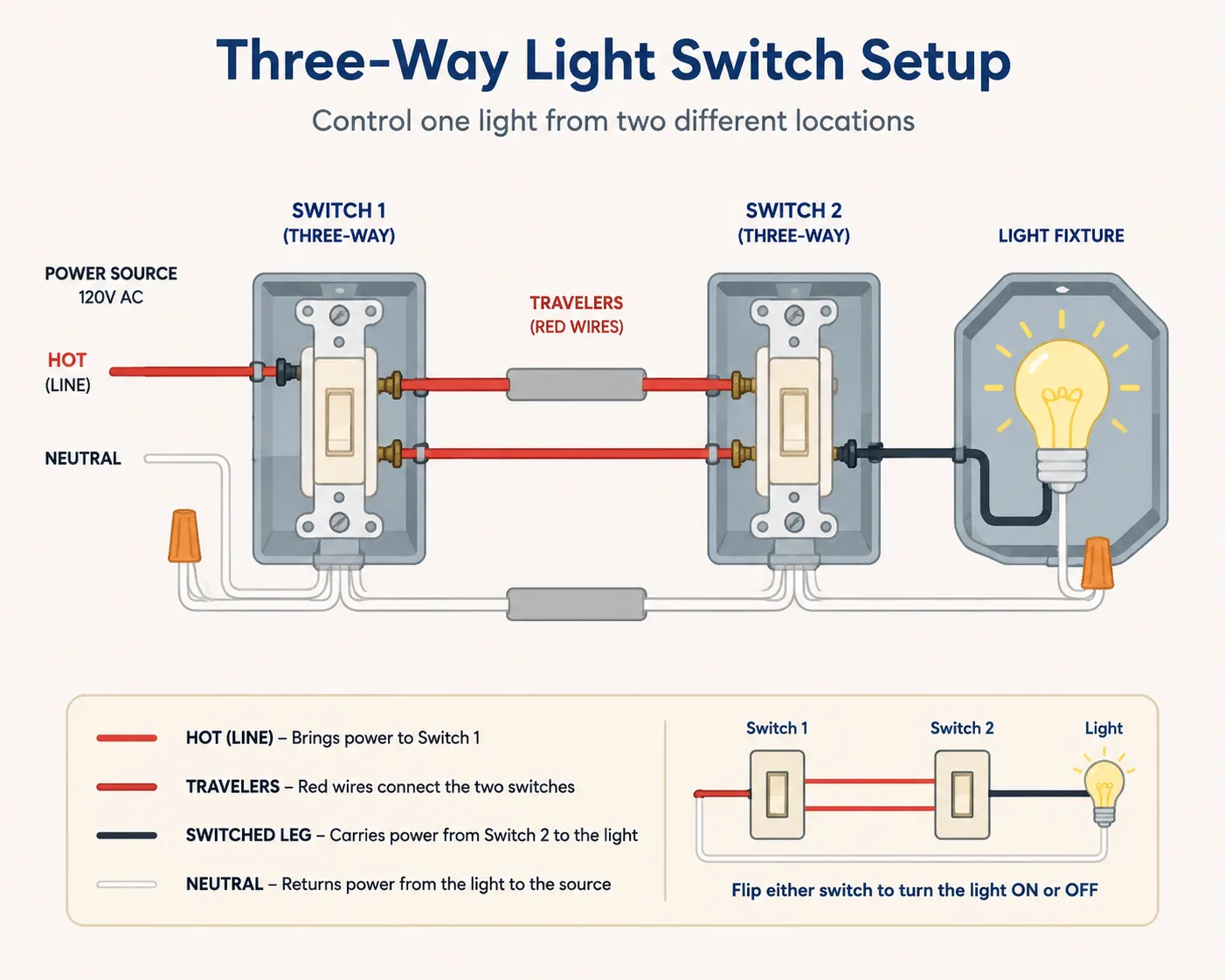
Three-way switches are where many homeowners first encounter red wires, and honestly, these systems confuse even experienced DIYers sometimes. Unlike standard single-pole switches that simply interrupt power flow, three-way switches reroute electricity through different pathways so a light can be controlled from two separate locations.
Imagine a staircase with a switch upstairs and another downstairs. You turn the light on at the bottom, walk upstairs, and turn it off there. That convenience is made possible through traveler wires connecting the switches together. Instead of a single hot wire running directly to the fixture, the switches continuously redirect current along alternate paths.
Electrical wiring references consistently explain that traveler systems rely on two conductors running between switches, commonly black and red wires inside a 14/3 or 12/3 cable.
How Three-Way Switches Actually Work
A standard three-way switch contains three active terminals:
- One common terminal
- Two traveler terminals
The traveler wires move current between the switches depending on switch position. When both switches align correctly, the circuit completes and the light turns on. Flip either switch, and electricity reroutes through the alternate traveler path, changing the light state.
Why Traveler Wires Matter
Traveler wires are essentially communication lanes between switches. They don’t permanently stay energized the same way a constant hot wire does. Instead, the energized path changes dynamically depending on switch position. That’s why testing traveler wires can sometimes produce confusing voltage readings if you don’t understand the switching logic.
Many residential systems use the red wire as one traveler and the black wire as the other traveler. The white wire usually remains neutral, though older systems occasionally repurpose white conductors improperly, which creates additional confusion and potential safety issues.
Why Red Wires Are Often Travelers
Electricians favor red conductors for traveler applications because the color helps visually separate traveler wires from standard line voltage conductors. It’s basically a visual shorthand inside crowded electrical boxes. When an electrician sees a red wire on brass traveler terminals, they immediately recognize a multi-way switching setup.
Still, appearances can deceive. Some homes use red wires for switched loads instead of travelers. Others may contain undocumented rewiring from previous renovations. That’s why professionals test circuits methodically instead of assuming every red wire automatically belongs to a traveler system.
Situations Where a Red Wire Carries Constant Power
One of the biggest misconceptions about red wires is the belief that they only function as traveler wires. In reality, many red conductors carry constant line voltage all the time. That distinction matters enormously because touching an energized conductor under the wrong assumption can result in electrical shock or equipment damage.
In multi-switch electrical boxes, electricians often use red wires to distribute incoming power to multiple switches. Picture a bathroom with separate switches for vanity lights, exhaust fans, and ceiling lighting. Instead of bringing separate power feeds into each switch, one incoming hot conductor may be split into multiple branch connections using red jumpers or pigtails.
Some switch loops also use red conductors to send unswitched power onward to another fixture or receptacle. In these cases, the red wire remains energized regardless of switch position. This becomes especially important when installing smart switches or dimmers because many modern devices require a constant hot connection.
Recent homeowner discussions and wiring examples show that red wires are frequently used as feed-through conductors in switch boxes supplying additional outlets or fixtures downstream. That means disconnecting a red wire carelessly can unexpectedly disable other devices in the circuit.
Older homes add another layer of complexity. Over decades, electrical systems evolve through renovations, additions, and repairs. One electrician may use red wires for travelers, while another uses them for switched legs or line feeds. After several remodeling projects, the wiring inside a single box can resemble spaghetti more than a neatly organized electrical system.
This is exactly why professional electricians treat every conductor as live until verified otherwise. A non-contact voltage tester, multimeter, or circuit tracer becomes far more valuable than relying on insulation color alone. Electricity doesn’t care what color the wire is wrapped in. It only cares whether the circuit path exists.
Why Wire Color Should Never Be Trusted Alone
This might be the single most important lesson in residential electrical work: wire color alone is never enough to identify a conductor safely. It’s helpful, yes. It’s standardized most of the time, yes. But it is not foolproof, and assuming otherwise can become dangerous quickly.
Electrical codes establish common color conventions to improve consistency and safety. Black and red wires are typically hot conductors, white wires are neutrals, and green or bare copper wires are grounds. The problem is that real homes don’t always remain code-perfect forever. Renovations, DIY repairs, aging systems, and outdated practices frequently create wiring situations that no longer match modern standards.
Recent electrical safety discussions highlight how older homes commonly contain improperly reidentified wires or outdated switch loop configurations. In some older switch loops, white wires were repurposed as hot conductors but never relabeled properly. That means a white wire that looks neutral may actually carry live voltage.
It gets even messier when homeowners attempt repairs without documenting their work. Someone may use leftover cable from another project, ignore color conventions, or splice conductors in unconventional ways. Twenty years later, the next homeowner opens the box and assumes the wiring follows standard logic when it absolutely does not.
Think of wire colors like jersey numbers in sports. They help identify players quickly, but they don’t guarantee what role each person is actually performing in the game. You still need to watch what’s happening before making assumptions.
Professional electricians rely on three things above all else:
- Voltage testing
- Circuit tracing
- Understanding circuit behavior
That combination reveals what the wiring is truly doing instead of what the colors suggest it should be doing.
Explore Related: How Long Should a Car Battery Last Without Driving in Daily Use
Safe Ways to Identify Electrical Wiring
If you encounter a red wire inside a light switch box, the safest approach is methodical investigation instead of guesswork. Electrical troubleshooting isn’t about bravery; it’s about patience and verification. The smartest electricians are usually the most cautious ones.
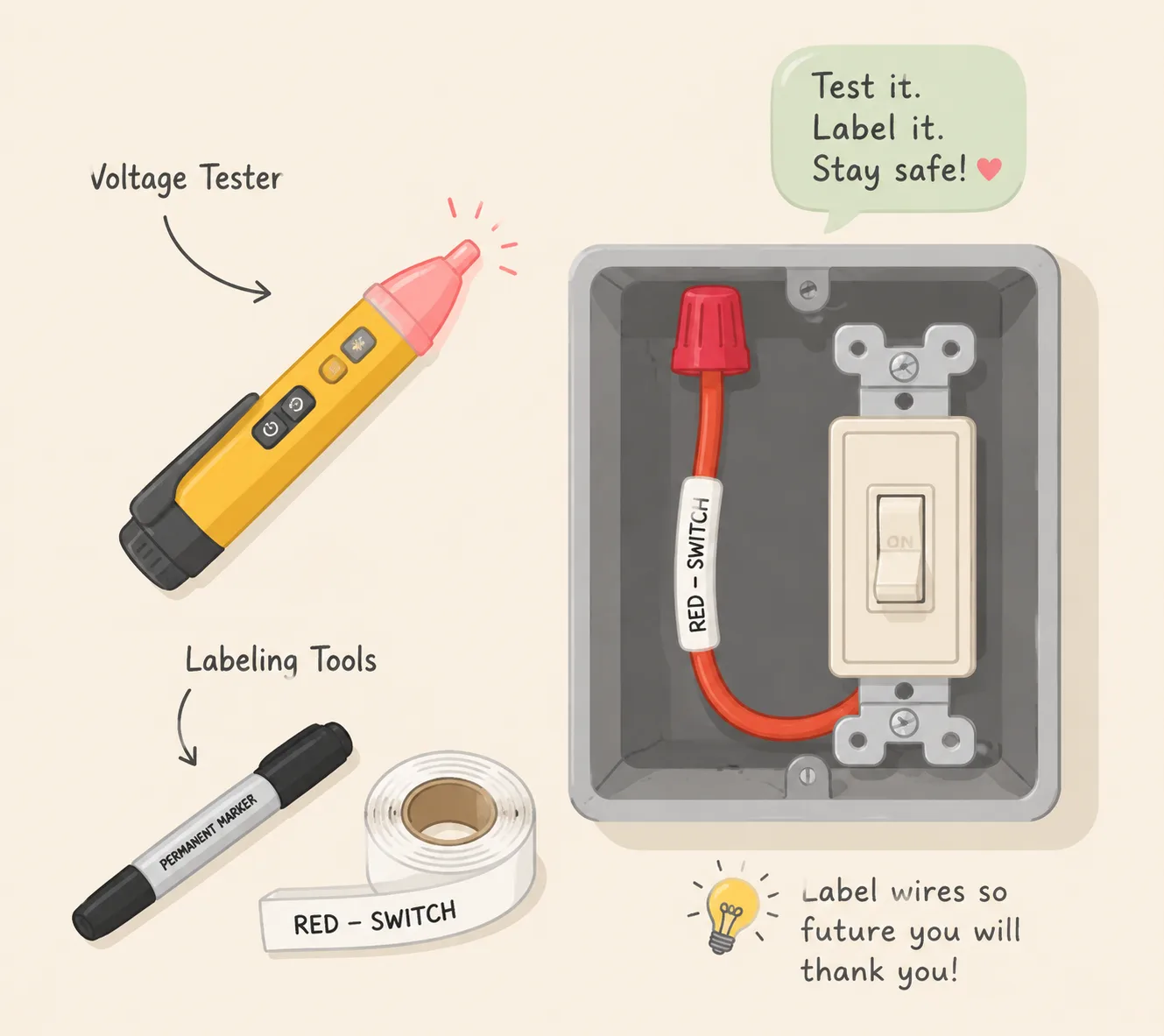
The first step is always turning off the correct circuit breaker. Even then, you should never assume the power is actually off until verifying with a tester. Mistaken breaker labeling happens constantly in older homes. Use a non-contact voltage tester first, then confirm readings with a multimeter if possible.
Using a Voltage Tester Properly
A non-contact tester can quickly identify whether a conductor is energized. Hold the tester near the insulated wire without touching exposed copper. If voltage exists, the tester alerts you through light or sound signals. This tool is incredibly useful for initial safety checks, though it shouldn’t be your only diagnostic method.
Multimeters provide deeper insight because they measure actual voltage between conductors. For example:
- Hot to neutral ≈ 120V
- Hot to ground ≈ 120V
- Neutral to ground ≈ near 0V
Those readings help distinguish line conductors, switched legs, and traveler wires.
Identifying Line, Load, and Traveler Wires
When diagnosing a three-way switch system, observe how voltage changes as switches move between positions. Traveler wires may alternate energized states depending on switch orientation. Constant hot conductors remain energized continuously.
Many electricians label wires with tape during troubleshooting to avoid confusion later. That simple habit can save enormous frustration during reassembly.
Here’s a practical comparison of common wire functions:
| Wire Function | Typical Behavior | Common Testing Result |
|---|---|---|
| Constant Hot | Always energized | 120V regardless of switch position |
| Switched Hot | Energized only when switch ON | Voltage changes with switch |
| Traveler Wire | Alternates paths between switches | Variable readings |
| Neutral | Return path | Near 0V to ground |
When to Call a Licensed Electrician
DIY electrical work can absolutely be manageable for basic tasks, but uncertainty is a warning sign, not a challenge. If multiple cables enter the box, conductors appear mislabeled, or breaker behavior seems inconsistent, bringing in a licensed electrician is often the safest choice.
Electricians have advanced diagnostic tools that quickly reveal circuit layouts hidden behind walls. More importantly, they understand local electrical code requirements and can identify hazardous wiring conditions homeowners might overlook entirely.
Electricity is incredibly useful, but it’s also unforgiving. Treating wiring systems carefully isn’t fear; it’s respect for a system powerful enough to run an entire home.
Conclusion
A red wire in a light switch usually signals a more advanced electrical configuration than a simple single-pole switch. In many homes, the red conductor functions as a traveler wire in three-way switching systems, allowing lights to be controlled from multiple locations. In other setups, the red wire may carry switched power, constant line voltage, or independent control for devices like ceiling fans and split outlets.
The biggest mistake homeowners make is assuming wire colors always tell the full story. Real-world wiring evolves over decades, and older homes frequently contain modifications, repurposed conductors, and nonstandard installations. That’s why professional electricians consistently rely on testing equipment rather than visual assumptions alone.
Understanding how red wires are commonly used gives you a major advantage when troubleshooting switches or replacing fixtures. Still, safe electrical work always starts with power verification, proper testing, and respect for the possibility that the wiring may not follow textbook conventions.
When in doubt, stop and verify. A few extra minutes spent testing wires safely can prevent electrical shock, damaged equipment, or far more serious hazards later.
FAQs
Is a red wire always hot in a light switch?
A red wire is typically a hot conductor or traveler wire, but its exact role depends on the circuit design. It may carry constant power, switched power, or traveler current between switches.
Can I connect a red wire to a black wire?
Only if the circuit design specifically requires it. Connecting wires incorrectly can create shorts, energized fixtures, or breaker trips. Always verify conductor purpose with testing equipment first.
Why does my light switch have both red and black wires?
This usually indicates a more complex switching arrangement such as a three-way switch, ceiling fan/light combo, switched outlet, or multi-load control setup.
What happens if a red wire is connected wrong?
Improper wiring can cause switches to malfunction, fixtures to remain permanently energized, breakers to trip, or dangerous shock hazards to develop.
Should I trust wire colors in old homes?
No. Older homes frequently contain rewired circuits, improperly labeled conductors, and outdated wiring methods. Always verify wiring with a tester instead of relying on color alone.

Colt Marlowe is a 29-year-old American content writer based in Boise, Idaho. He specializes in technology, digital tools, and online business topics, combining years of research with practical experience to produce clear, trustworthy articles. As a contributor to wirelogic.online, he focuses on creating well-researched, reader-friendly content that emphasizes accuracy, transparency, and long-term value for audiences seeking reliable information.