

A car battery is a bit like a sleeping athlete. Even while resting, it still burns energy in the background. Many drivers assume that once the engine is off, the battery simply pauses and waits patiently until the next drive. That sounds logical, but modern vehicles don’t really “sleep” completely anymore. Between onboard computers, alarms, keyless entry systems, clocks, infotainment memory, and natural chemical reactions inside the battery itself, power is constantly being used little by little. Leave a vehicle sitting long enough, and eventually the battery waves the white flag.
What surprises most people is how quickly this can happen. A healthy battery in good weather may survive several weeks without trouble, while an older battery parked during a hot summer can struggle in half that time. Temperature, battery age, battery type, and even the cleanliness of the terminals all influence how long a parked vehicle can sit before refusing to start. Studies and technician reports consistently show that traditional lead-acid batteries lose charge naturally even when disconnected, often around 3–5% per month under moderate conditions. Heat speeds up this process dramatically.
The real headache begins when a battery stays discharged too long. That is when sulfation starts forming on the internal lead plates like rust slowly creeping through metal pipes. Once sulfation becomes severe, charging the battery may no longer fully restore it. In many cases, the battery eventually reaches a point where replacement is the only realistic solution. Understanding how battery drain works can save drivers money, prevent roadside emergencies, and extend battery lifespan significantly.
Understanding Why Car Batteries Drain While Parked
Most people imagine a parked car as an inactive machine, almost frozen in time until the ignition key turns again. In reality, your vehicle behaves more like a smartphone left on standby mode. Even though the screen is dark, background systems continue running quietly. A car battery experiences exactly the same thing. Tiny amounts of power disappear every hour whether the vehicle moves or not. This gradual loss comes from two separate forces working together: internal self-discharge and external electrical drain.
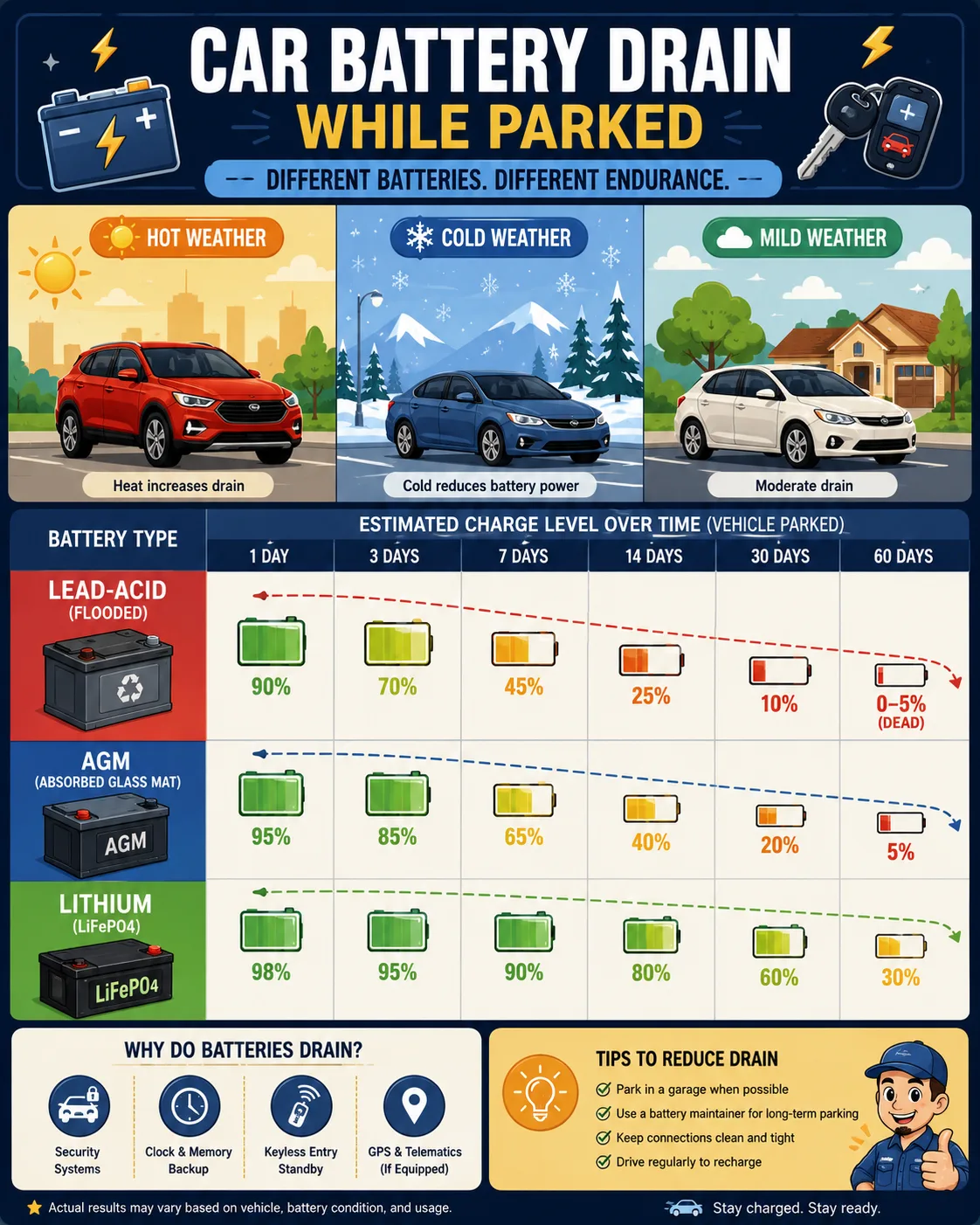
The first culprit is chemistry itself. Every lead-acid battery contains chemical reactions between lead plates and sulfuric acid. Those reactions never fully stop, even when the car is parked. Over time, stored energy slowly escapes. Research on automotive lead-acid batteries shows most standard batteries lose around 3–5% of their charge each month at room temperature. AGM batteries generally perform slightly better, often losing closer to 1–3% monthly.
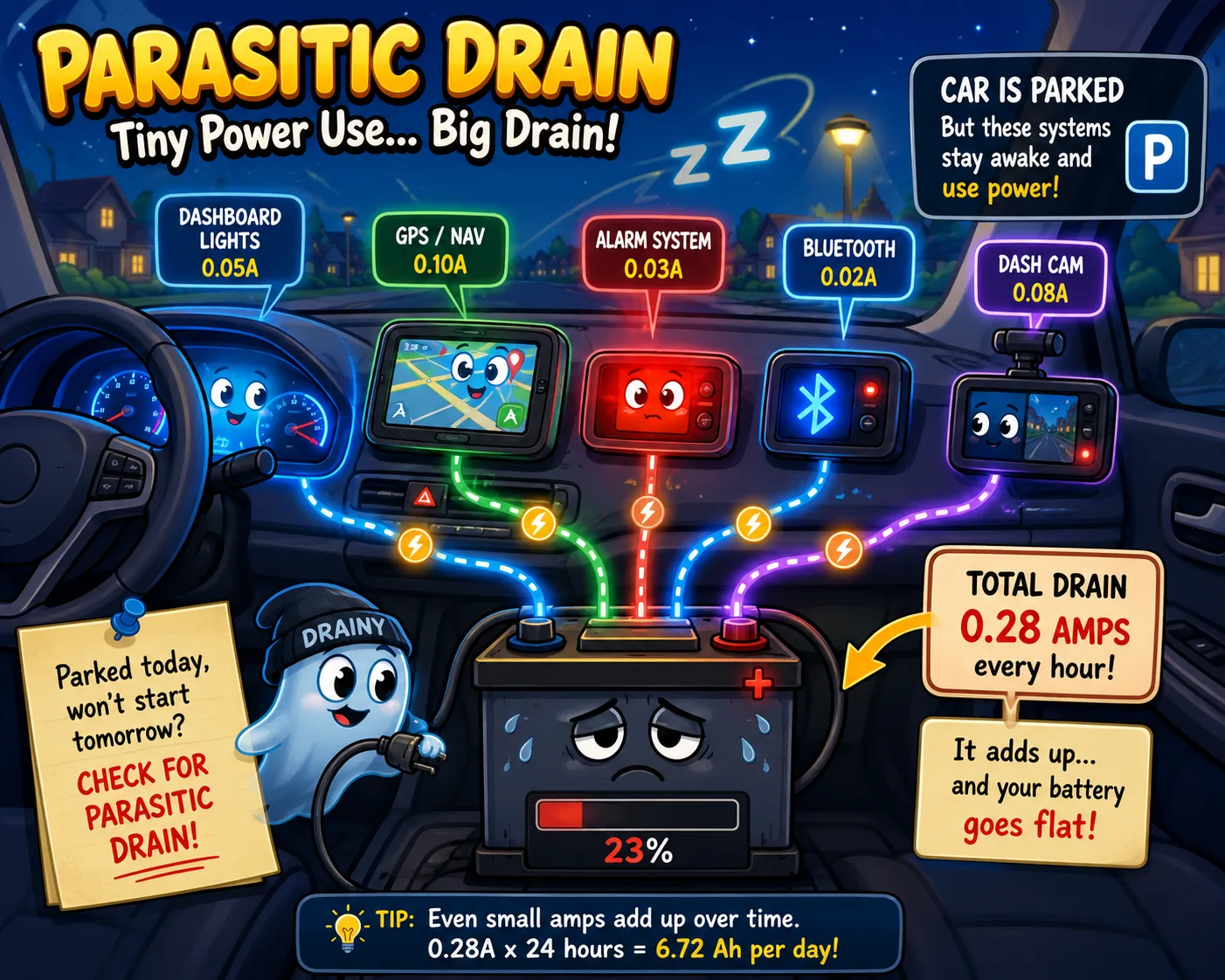
The second issue is something mechanics call parasitic drain. That sounds dramatic, but it simply refers to electronics quietly consuming power after shutdown. Modern cars are packed with small systems that stay alive all the time. Your security alarm listens for threats. The clock keeps accurate time. The ECU remembers driving settings. Keyless entry modules continuously wait for your remote signal. Separately, each system uses tiny amounts of electricity. Together, they create a slow but constant drain on the battery.
This explains why a vehicle that sits untouched for weeks may suddenly refuse to start despite having no obvious problem. The battery was not “bad” overnight. It simply ran out of stored energy little by little, like water dripping from a faucet into an empty sink.
How Long Can a Typical Car Battery Sit Unused?
Drivers often ask a simple question: “How long can my car sit before the battery dies?” The tricky part is that there is no universal answer. Battery type, climate, vehicle age, and electrical systems all change the timeline. Still, mechanics and battery manufacturers generally agree on realistic expectations.
A healthy standard lead-acid battery in mild weather usually survives about two to four weeks before noticeable weakening begins. Some vehicles may last longer, especially older models with fewer electronic systems. Under ideal storage conditions, fully charged batteries can sometimes remain usable for several months. However, once the voltage drops too low, permanent damage becomes increasingly likely. Experts note that batteries stored at moderate temperatures may safely sit for roughly 6–12 months if disconnected and periodically maintained.
AGM batteries handle inactivity better because their internal design reduces self-discharge and resists sulfation more effectively. Lithium automotive batteries perform even better, often holding charge for extended periods with minimal loss. Still, no battery is immune to time. Even premium battery technologies slowly drain when unused.
The following table gives a practical overview:
| Battery Type | Average Self-Discharge Rate | Typical Unused Survival Time |
|---|---|---|
| Flooded Lead-Acid | 3–6% monthly | 2–4 weeks before weak starting |
| AGM Battery | 1–3% monthly | 1–3 months |
| Lithium Automotive | 2–3% monthly | Several months |
Heat shortens these estimates dramatically. Vehicles parked in extremely hot environments may experience battery failure in as little as six to eight weeks.
That means the person leaving a car parked during a long vacation, military deployment, remote work assignment, or winter storage period should never assume the battery will magically stay healthy without preparation.
What Happens to a Battery When a Car Sits Too Long
A neglected battery ages like food forgotten in the back of a refrigerator. At first, nothing seems wrong. Then slowly, hidden damage spreads until the entire thing becomes unusable. Inside an idle battery, several destructive processes begin developing once charge levels fall too low.
The most dangerous problem is sulfation. During normal discharge, lead sulfate crystals naturally form on the battery plates. Under ordinary driving conditions, recharging reverses this process. But when a battery sits partially discharged for extended periods, those crystals harden permanently. Think of it like plaque building up inside arteries. The hardened sulfate reduces the battery’s ability to hold and deliver power. Over time, starting performance weakens, charging efficiency drops, and eventually the battery cannot recover at all.
Heat accelerates the damage even further. High temperatures increase internal corrosion, evaporate electrolyte fluid in flooded batteries, and speed up chemical breakdown. The hotter the environment, the faster the internal components deteriorate. One source notes that self-discharge rates can nearly double with every 10°C rise in temperature.
Cold weather creates different problems. While cold temperatures slow self-discharge, they also reduce available battery capacity. A weak battery may technically still contain charge but lack enough power to crank the engine. In severe freezing conditions, a deeply discharged battery can even freeze internally, cracking the case and permanently destroying it.
These issues explain why leaving a car unused for months without preparation can silently ruin an otherwise decent battery. The battery does not simply “go dead.” It chemically deteriorates from the inside out.
Temperature Conditions That Speed Up Battery Drain
Temperature plays such a massive role in battery health that mechanics often compare batteries to athletes running in extreme weather. Push them too hard in scorching heat or brutal cold, and performance suffers quickly. Surprisingly, heat is usually the bigger enemy.
Most drivers blame winter for battery problems because failures become obvious on freezing mornings. Yet hot weather quietly causes more long-term destruction. High temperatures accelerate chemical reactions inside the battery, increasing self-discharge and internal corrosion simultaneously. At around 30°C (86°F), self-discharge rates may climb to 8–10% monthly compared to around 3% in cooler environments.
A car parked outside in summer heat essentially ages faster every single day. Under-hood temperatures can soar far above ambient air temperature, especially in darker vehicles parked directly under sunlight. Electrolyte fluid evaporates more quickly, lead plates corrode faster, and sulfation develops aggressively once voltage begins dropping.
Cold weather tells a different story. Lower temperatures slow self-discharge considerably, sometimes below 1% monthly. That sounds beneficial, but there is a catch. Cold thickens the electrolyte solution and reduces the battery’s ability to deliver current. A battery that easily starts a car at 70°F may suddenly struggle at 10°F despite holding the same charge level.
This is why drivers often experience dead batteries during winter after the car has been sitting for several weeks. The battery may not actually be empty. It simply cannot provide enough cranking power in freezing conditions.
Garage storage helps enormously because stable temperatures reduce stress on the battery. Even a shaded parking structure can make a noticeable difference compared to direct outdoor exposure.
More Details: What Is a Load Test for a Battery and Why It Matters
Vehicle Electronics That Continue Drawing Power
Modern vehicles are technological marvels, but all that convenience comes with a hidden cost. Your car never truly turns off anymore. Instead, it enters a low-power standby mode where dozens of systems continue quietly operating behind the scenes.
One of the largest contributors to parasitic drain is the security system. Alarm modules, motion sensors, and keyless entry receivers constantly wait for signals. They are like guards standing watch 24 hours a day. Each device individually draws only tiny amounts of electricity, often measured in milliamps, but over weeks those tiny demands add up significantly.
Infotainment systems also consume background power. Modern vehicles store radio presets, Bluetooth pairings, navigation data, and user profiles in memory. Engine control units preserve adaptive learning settings for smoother driving performance. Some luxury vehicles maintain communication between multiple onboard computers even while parked.
Then there are the sneaky electrical problems drivers never notice. A faulty relay, trunk light, glovebox light, or malfunctioning aftermarket accessory can create excessive drain without obvious symptoms. These hidden issues often explain why one vehicle survives a month parked while another dies within days.
Here are common components that continue drawing battery power:
- Alarm and anti-theft systems
- Keyless entry receivers
- ECU memory functions
- Clock and radio memory
- GPS tracking systems
- Dash cameras
- Aftermarket stereo systems
- Bluetooth modules
A healthy vehicle typically maintains a low parasitic draw that the battery can tolerate temporarily. Problems arise when the car sits too long or the battery is already aging.
Warning Signs Your Battery Is Losing Charge
Batteries rarely fail without warning. The problem is that many drivers overlook the signs until the engine refuses to start entirely. Learning to recognize early symptoms can save a lot of frustration and prevent getting stranded in the worst possible moment.
The first warning sign is usually slow engine cranking. Instead of the engine starting with a confident burst, it sounds sluggish and hesitant. That dragging sound is the starter motor begging for more power than the battery can comfortably provide. Sometimes the car still starts, which tricks drivers into ignoring the issue. Yet the battery is already signaling weakness.
Another clue appears in the lighting system. Headlights may look dimmer than usual, especially during startup. Interior lights can flicker briefly when turning the ignition key. Dashboard electronics may behave strangely or reset unexpectedly. Modern vehicles sometimes display battery or charging system warnings long before total failure occurs.
Voltage readings also reveal battery condition. A fully charged healthy car battery generally rests around 12.6 volts. Once voltage falls closer to 12.2 volts, the battery is partially discharged. At lower levels, sulfation risk increases significantly. Many mechanics recommend recharging batteries once they approach this range during storage.
Sometimes the symptoms become physical. Corrosion around battery terminals, swelling of the battery case, leaking fluid, or a sulfur-like rotten egg smell can all indicate internal deterioration.
Ignoring these signs is a bit like ignoring chest pain before a heart attack. The system may keep functioning temporarily, but failure becomes increasingly likely with every passing day.
Best Ways to Extend Battery Life During Inactivity
The good news is that preventing battery drain is far easier and cheaper than replacing a dead battery every couple of years. A few simple habits can dramatically extend battery life during long storage periods.
One of the easiest methods is disconnecting the negative battery terminal. Doing this cuts power to most parasitic drains inside the vehicle. The battery will still self-discharge naturally, but much more slowly. This technique works especially well for seasonal vehicles stored for several months.
Driving the vehicle periodically also helps, but there is an important catch. Short engine starts without proper driving may actually hurt more than help. Starting the engine consumes significant battery power. If the vehicle only idles briefly before shutting off again, the alternator may never fully recharge what was used. Ideally, the car should be driven at least 20–30 minutes at highway speeds to restore charge effectively.
Keeping terminals clean matters too. Dirt, corrosion, and moisture can create tiny electrical leakage paths that slowly drain power. A simple cleaning with baking soda and water can reduce unwanted discharge.
Storage location makes a major difference as well. Parking in a cool, dry garage protects the battery from extreme temperatures that accelerate aging. Heat especially should be avoided whenever possible.
Some drivers also remove the battery entirely during very long storage periods. Stored indoors at moderate temperatures and periodically recharged, a disconnected battery generally survives much longer.
These preventative habits cost almost nothing yet can add years to battery lifespan.
When a Battery Tender Becomes Essential
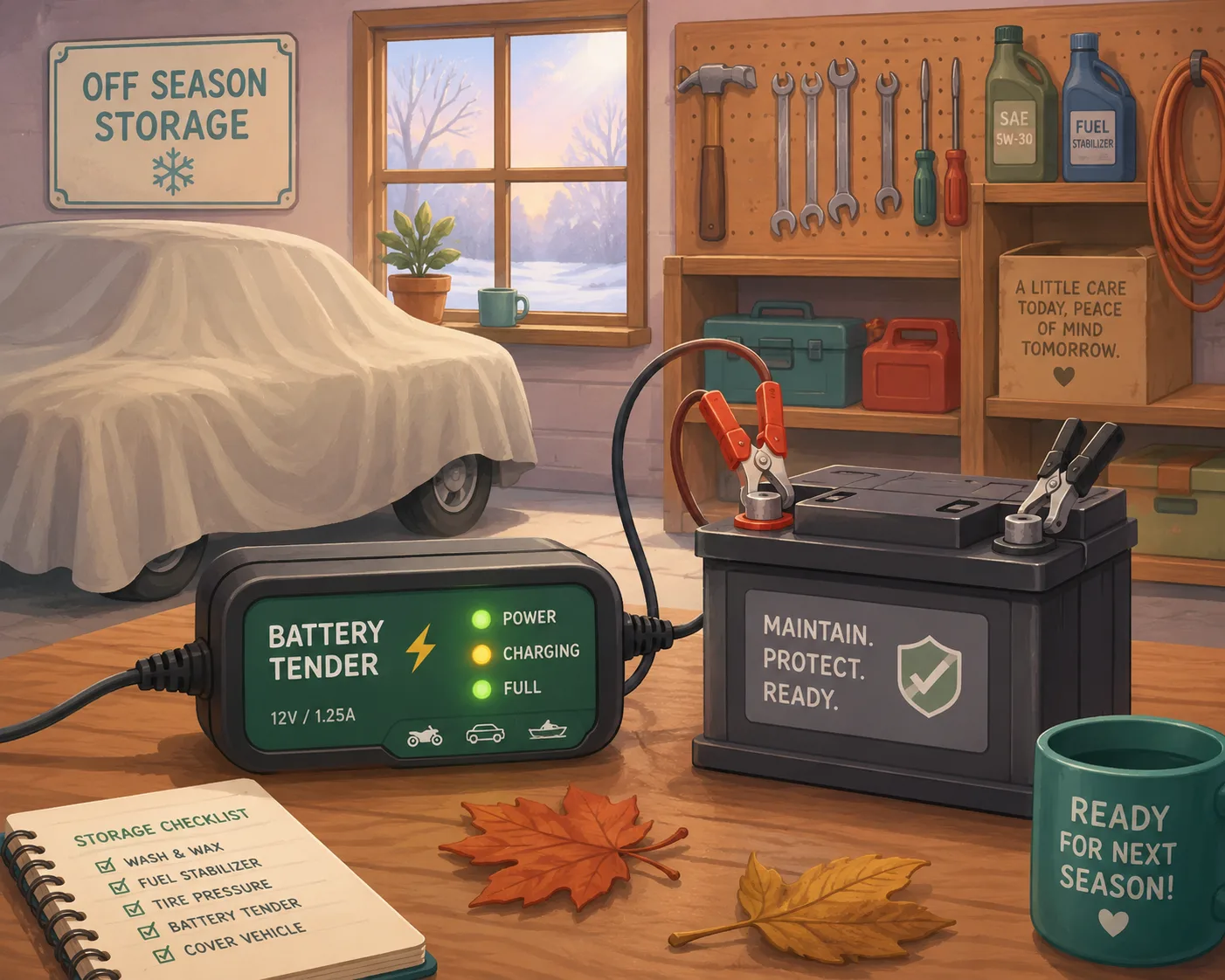
For vehicles that sit unused regularly, a battery tender or smart maintainer becomes one of the smartest investments possible. Think of it as life support for your battery. Instead of allowing the battery to slowly weaken and discharge, the tender continuously monitors voltage and supplies tiny amounts of power only when needed.
Unlike old-fashioned chargers that constantly push electricity into the battery, modern smart maintainers work intelligently. Once the battery reaches full charge, the device switches into maintenance mode automatically. This prevents overcharging while keeping the battery healthy and ready for use.
Battery tenders become especially valuable for:
- Collector cars
- Seasonal convertibles
- Motorcycles
- RVs
- Vacation vehicles
- Military deployment storage
- Snowbird travel vehicles
- Cars driven infrequently
Experts commonly recommend using a maintainer whenever storage exceeds about 30 days.
The difference can be dramatic. Batteries maintained on smart chargers often last years longer than neglected batteries left to self-discharge repeatedly. It is similar to maintaining proper hydration during exercise instead of repeatedly allowing dehydration and recovery cycles.
Some modern maintainers also include desulfation features that help reduce sulfate buildup during storage. While they cannot resurrect severely damaged batteries, they can slow deterioration significantly.
For anyone storing a vehicle long term, a battery tender is not really a luxury anymore. It is preventative maintenance.
Knowing When the Battery Has Reached the End of Its Life
Even with perfect maintenance, every car battery eventually wears out. Lead-acid batteries are consumable components, much like tires or brake pads. The trick is recognizing when the battery has crossed the line from weak to unreliable.
Most standard automotive batteries last around three to five years under normal conditions. Extreme climates shorten lifespan considerably. Hot environments are especially brutal because constant heat accelerates internal corrosion. Batteries in desert climates often fail much sooner than those in moderate regions.
Repeated deep discharges also shorten lifespan dramatically. Every time a lead-acid battery drops too low, sulfation and plate damage increase. A battery repeatedly drained during storage ages much faster than one consistently maintained near full charge.
Common signs replacement is necessary include:
| Symptom | What It Usually Means |
|---|---|
| Slow cranking every morning | Reduced cold-cranking capacity |
| Frequent jump starts needed | Battery can no longer hold charge |
| Voltage drops quickly after charging | Internal sulfation or cell failure |
| Swollen battery case | Heat damage or overcharging |
| Age over 5 years | Natural wear and declining reliability |
Sometimes a battery appears to recover after charging but quickly weakens again days later. That is often a sign the internal capacity has permanently diminished.
Drivers should also remember that modern vehicles place heavier demands on batteries than older cars ever did. Advanced electronics, stop-start systems, sensors, and infotainment technology require stronger and more reliable electrical performance. An aging battery may technically still function yet struggle under modern demands.
Replacing a failing battery proactively is usually cheaper and safer than waiting for complete failure during a freezing morning or a remote road trip.
Conclusion
A parked car may look inactive, but its battery continues fighting a quiet battle against chemistry, electronics, temperature, and time. Even when unused, batteries naturally self-discharge while modern vehicle systems slowly drain additional power in the background. Under ideal conditions, a healthy battery may survive several weeks or even months without driving, but heat, age, and parasitic drain can shorten that timeline dramatically.
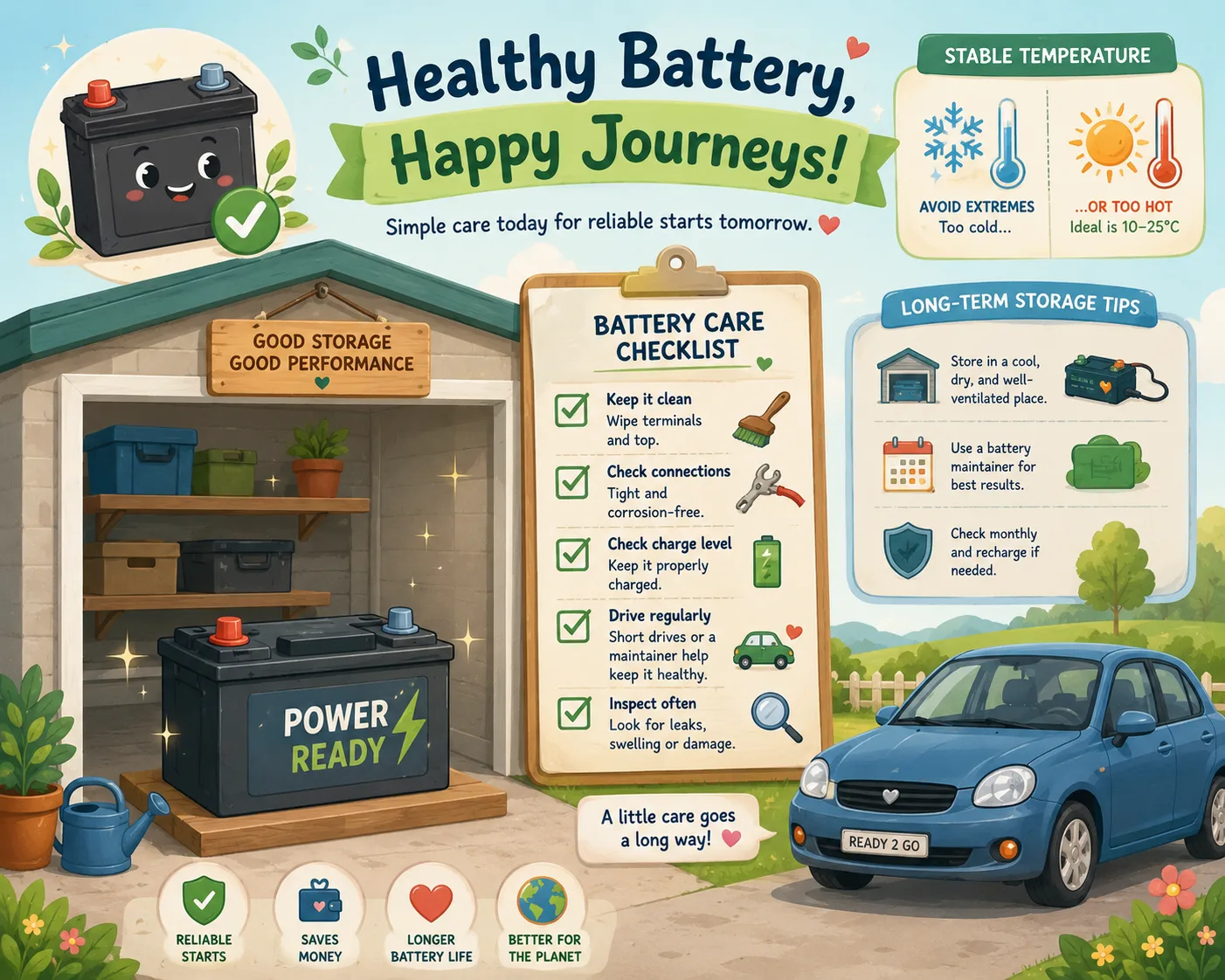
The biggest threats are not always obvious. Sulfation, corrosion, and deep discharge silently reduce battery capacity long before total failure occurs. That is why preventative maintenance matters so much. Driving the vehicle properly, disconnecting the battery during long storage, cleaning terminals, parking in moderate temperatures, and using a smart battery tender can significantly extend battery life.
Understanding the warning signs also helps drivers avoid unpleasant surprises. Slow cranking, dim lights, rapid voltage loss, and repeated jump starts all signal a battery approaching the end of its lifespan.
A car battery is a little like a rechargeable reservoir. Leave it neglected long enough, and the water level slowly disappears. Maintain it carefully, though, and it can reliably power your vehicle for years.
Check Also: How to Know If an Outlet Is Grounded Before Using It
FAQs
How long can a car sit before the battery dies?
Most healthy car batteries can sit unused for about two to four weeks before noticeable weakening begins. AGM batteries generally last longer, while hot weather shortens survival time significantly.
Does disconnecting the battery stop it from draining?
Disconnecting the negative terminal greatly reduces drain by stopping most parasitic electrical loads. However, the battery will still slowly self-discharge naturally over time.
Is it bad to start a car occasionally without driving it?
Yes. Brief startups without proper driving may drain the battery more than recharge it. The alternator needs enough driving time, usually 20–30 minutes, to restore lost charge effectively.
Can a dead battery recover after sitting unused?
Sometimes. If the battery was only lightly discharged, recharging may restore it. Severe sulfation from long-term discharge often causes permanent damage that charging cannot fully reverse.
What is the best way to store a car long term?
The best approach is storing the vehicle in a cool, dry location while using a smart battery maintainer. Disconnecting the battery and periodically checking voltage also helps preserve battery health.

Colt Marlowe is a 29-year-old American content writer based in Boise, Idaho. He specializes in technology, digital tools, and online business topics, combining years of research with practical experience to produce clear, trustworthy articles. As a contributor to wirelogic.online, he focuses on creating well-researched, reader-friendly content that emphasizes accuracy, transparency, and long-term value for audiences seeking reliable information.