
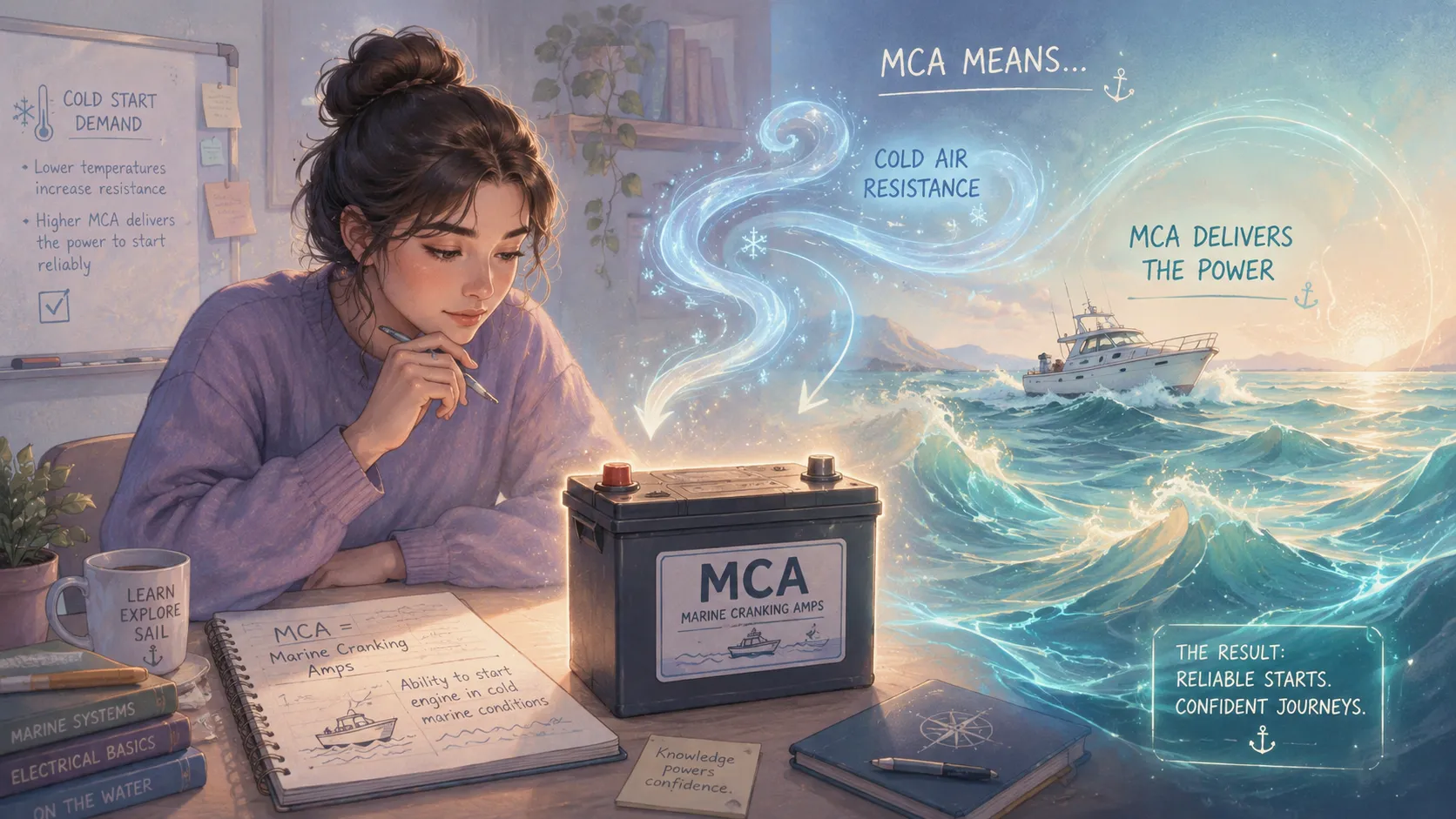
When you shop for a marine battery, you’ll probably notice a confusing alphabet soup printed on the label. MCA, CCA, CA, RC, and Ah all compete for your attention like road signs during a storm. Among them, one of the most misunderstood ratings is MCA, short for Marine Cranking Amps. Many boat owners assume MCA is just another version of CCA, while others believe a bigger number automatically means a better battery. Reality is a little more nuanced.
Modern marine engines rely heavily on battery performance, especially as boats become packed with electronics, GPS systems, fish finders, trolling motors, and onboard accessories. Choosing the wrong battery rating can leave you stranded at the dock or fighting a no-start situation in rough conditions. Understanding MCA is not just technical trivia; it directly affects reliability, engine starting performance, and battery longevity.
Recent battery industry resources explain that MCA ratings are designed specifically for marine environments and are measured differently from automotive CCA ratings. Batteries naturally produce more power in warmer temperatures, which is why MCA values usually appear higher than comparable CCA numbers.
Before you buy your next marine battery, it helps to understand exactly what MCA means, how it differs from other ratings, and when it matters most. Let’s break it down step by step.
Understanding Marine Cranking Amps
The Official Definition of MCA
MCA stands for Marine Cranking Amps, a rating that measures how much current a 12-volt marine battery can deliver for 30 seconds at 32°F (0°C) while maintaining at least 7.2 volts. In simple language, MCA tells you how much starting power the battery can provide under moderate marine conditions. Industry references from marine battery manufacturers and technical guides consistently use this definition.
Think of MCA like the “sprint strength” of a marine battery. Starting a boat engine requires a massive burst of electricity in a short amount of time. Your battery doesn’t slowly ease into action; it explodes with energy for a few seconds to crank the starter motor. MCA measures how effectively it can perform that task.
Marine environments are different from automotive environments in several important ways. Boats usually operate in milder temperatures compared to vehicles exposed to freezing winter mornings. Because of that, marine batteries are tested at a warmer temperature than automotive batteries. That warmer testing environment allows batteries to produce more current, which is why MCA ratings often look impressively high.
The concept becomes easier to understand if you imagine an athlete running on a warm day versus a freezing day. On a warm day, muscles respond faster and performance improves. Batteries behave similarly because their chemical reactions become more efficient at higher temperatures.
Why Marine Batteries Use MCA Ratings
Marine engines face unique operating conditions. Boats experience constant vibration, moisture exposure, wave impact, and long idle periods between uses. Unlike cars that typically start daily, marine batteries may sit unused for weeks and still need to deliver instant starting power when called upon.
Battery manufacturers use MCA because it better reflects realistic marine operating temperatures. Most boaters are not launching vessels into icy lakes during subzero conditions. They’re operating in spring, summer, and moderate coastal weather where temperatures are significantly warmer.
According to recent marine battery technical resources, MCA ratings are particularly relevant for:
- Outboard motors
- Personal watercraft
- Fishing boats
- Recreational marine engines
- Coastal boating applications
That doesn’t mean CCA becomes irrelevant. In colder northern climates, boat owners still need to consider cold-weather starting ability. But for typical marine applications, MCA provides a more realistic measurement of actual operating conditions.
How MCA Ratings Are Measured
Temperature Conditions Used During Testing
Temperature dramatically changes how a battery performs. This is the entire reason MCA and CCA exist as separate ratings in the first place.
Marine Cranking Amps are tested at:
<math xmlns=”32∘F=0∘C32^circ F = 0^circ C
Cold Cranking Amps are tested at:
<math xmlns=”0∘F=−18∘C0^circ F = -18^circ C
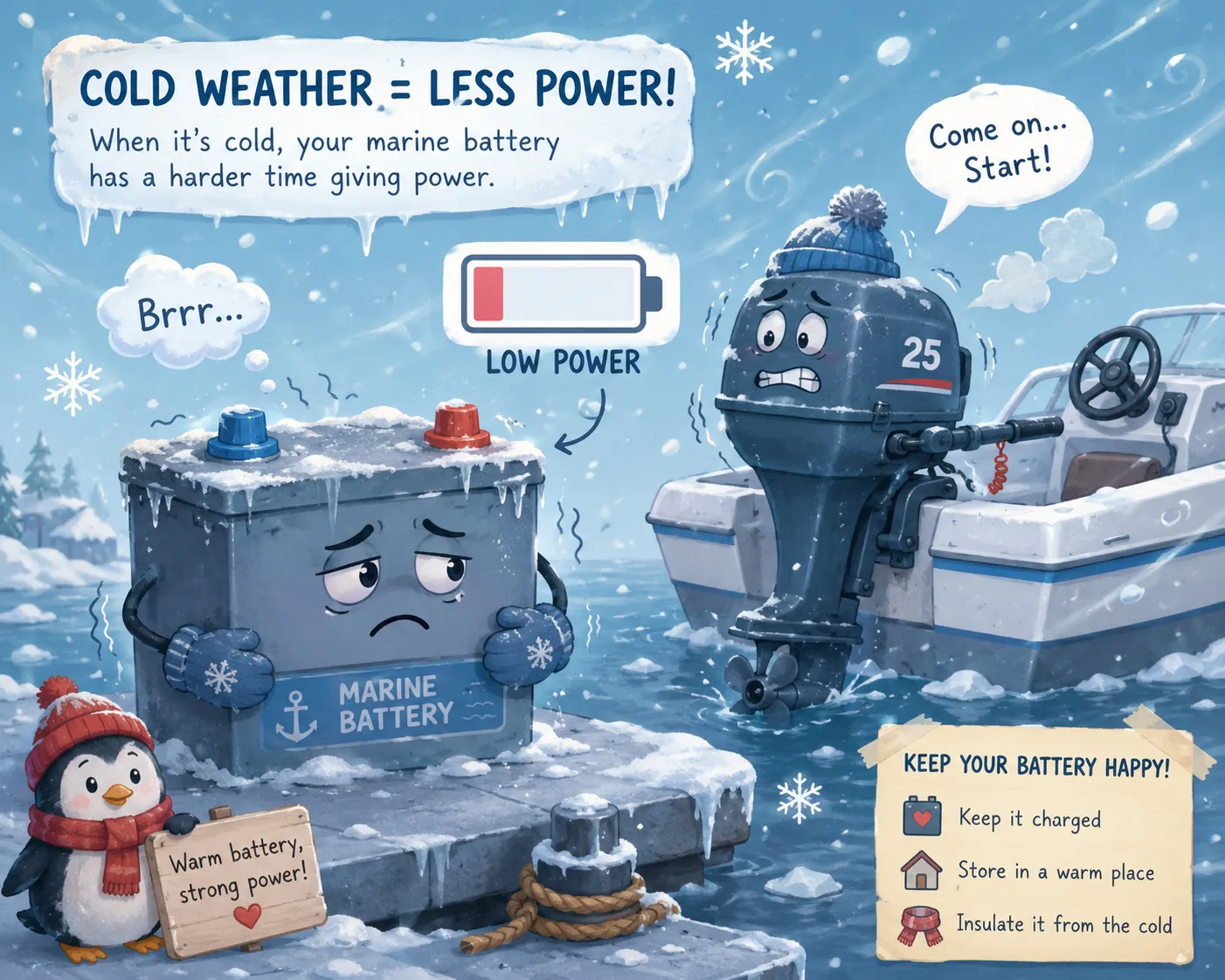
That temperature difference may not sound enormous, but inside a battery it changes everything. Lead-acid batteries rely on chemical reactions between lead plates and electrolyte fluid. Cold temperatures slow those reactions significantly, reducing the battery’s ability to deliver current.
Recent technical battery explanations note that batteries can lose between 20% and 50% of their effective capacity in freezing temperatures.
This explains why MCA numbers are higher than CCA numbers for the exact same battery. The warmer test environment allows the battery to perform better.
Voltage Requirements During the Test
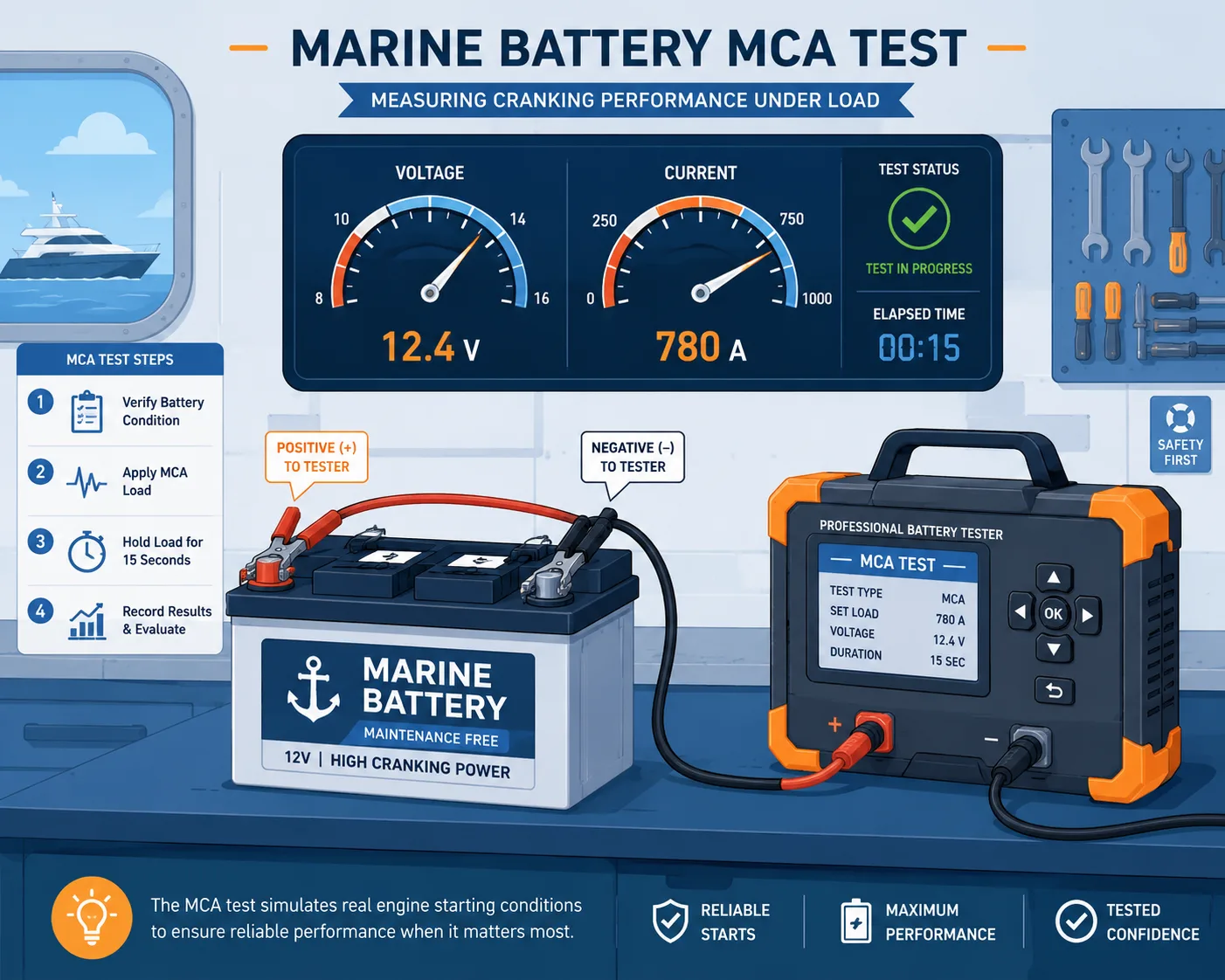
MCA testing follows a strict standard. The battery must maintain a minimum voltage of 7.2 volts during the entire 30-second discharge test. If voltage drops below that threshold too quickly, the battery fails the rating.
This matters because high current alone isn’t enough. A battery must also sustain stable voltage under load. Imagine trying to start an engine with a battery that delivers a quick power spike but immediately collapses afterward. The starter motor would struggle or fail completely.
Battery testers simulate this heavy electrical demand using professional load-testing equipment. During the test, engineers evaluate:
- Current output
- Voltage stability
- Duration of discharge
- Recovery characteristics
The result becomes the official MCA rating printed on the battery label.
MCA vs CCA
What Cold Cranking Amps Mean
CCA, or Cold Cranking Amps, measures how many amps a battery can supply for 30 seconds at 0°F (-18°C) while maintaining at least 7.2 volts.
Automotive manufacturers rely heavily on CCA because cars frequently operate in freezing winter conditions. Cold oil thickens, engine resistance increases, and batteries weaken simultaneously. It’s basically a perfect storm for starting problems.
CCA ratings help determine whether a vehicle can reliably start during harsh winter mornings. The colder the climate, the more important CCA becomes.
Why MCA Numbers Are Usually Higher
A common mistake people make is assuming MCA and CCA measure different kinds of power. They actually measure the same type of performance under different temperatures.
Because batteries work better in warmer conditions, MCA ratings usually appear around 20–25% higher than CCA ratings for the same battery.
For example:
| Battery Type | CCA Rating | MCA Rating |
|---|---|---|
| Marine Battery Example | 640 CCA | 800 MCA |
| Larger Marine Battery | 800 CCA | 1000 MCA |
That doesn’t mean the second battery magically became stronger. It simply performed better in warmer testing conditions.
Real-World Comparison Between MCA and CCA
Imagine two boat owners shopping for batteries. One sees an 850 MCA battery and assumes it’s automatically stronger than a 700 CCA battery. That comparison is misleading because the ratings were measured differently.
Comparing MCA directly to CCA is like comparing sprint times on different race tracks. Conditions matter.
If you operate a boat in Florida, southern California, or coastal regions with moderate weather, MCA ratings provide a realistic picture of starting performance. If you launch boats in freezing northern climates, CCA becomes much more important.
Why Temperature Changes Battery Performance
Chemical Reactions Inside Lead-Acid Batteries
Batteries are basically controlled chemical reactors. Inside a lead-acid battery, sulfuric acid interacts with lead plates to generate electricity. Heat accelerates these chemical reactions, while cold slows them down.
That’s why batteries feel “weaker” in winter. The chemistry literally becomes sluggish.
The effect can be dramatic. A battery that starts an engine effortlessly at 80°F may struggle badly near freezing temperatures. At the same time, cold engine oil thickens and increases resistance inside the engine itself. So while the battery produces less power, the engine simultaneously requires more power. It’s a double challenge.
Battery experts consistently emphasize this relationship between temperature and starting performance.
How Cold Weather Reduces Starting Power
Cold weather affects marine batteries in several ways:
| Cold Temperature Effect | Impact on Battery |
|---|---|
| Slower chemical activity | Reduced current output |
| Increased internal resistance | Lower voltage stability |
| Thickened engine oil | Harder engine cranking |
| Reduced charging efficiency | Slower recovery |
This explains why winter battery failures are incredibly common.
You’ve probably experienced it yourself. A car or boat that started perfectly last week suddenly struggles after a cold night. The battery didn’t instantly die; it simply lost enough effective performance that the engine became harder to crank.
Choosing the Right Battery for Marine Applications
Outboard Boats
Outboard motors require reliable bursts of starting power, especially larger engines with higher compression ratios. Manufacturers typically specify recommended MCA or CCA ranges depending on engine size.
Choosing too little starting power creates unreliable ignition and excessive battery stress. Choosing excessively oversized batteries adds unnecessary cost and weight.
For most recreational outboard boats operating in moderate climates, MCA ratings are highly relevant because they reflect realistic marine operating conditions.
Fishing Boats and Electronics
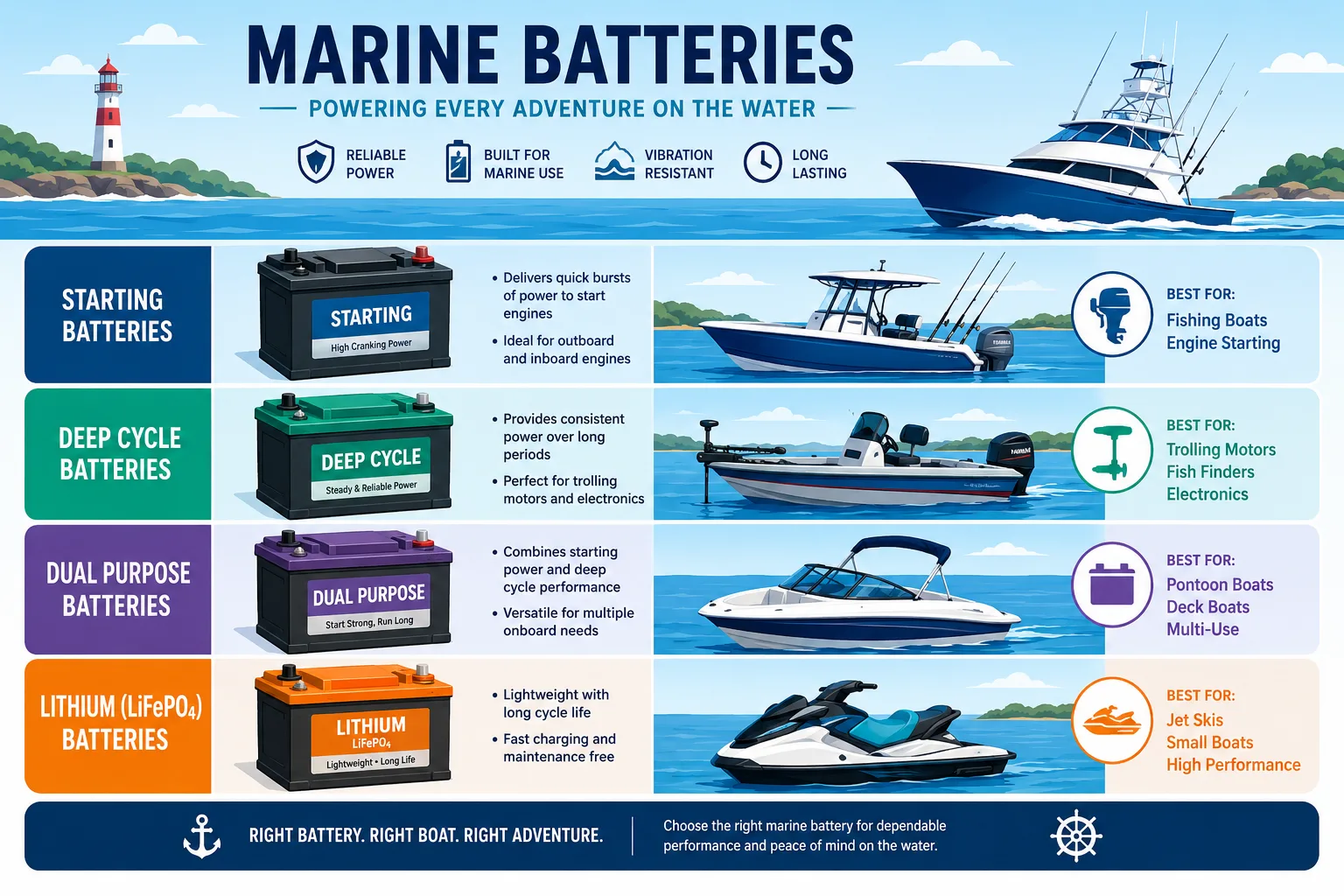
Modern fishing boats resemble floating electronics centers. Between fish finders, sonar systems, GPS units, radios, trolling motors, lighting systems, and onboard pumps, electrical demand can become substantial.
This is where many boat owners make a major mistake: focusing only on MCA.
Starting power matters, but so does:
- Reserve capacity
- Amp-hour rating
- Deep-cycle durability
A battery with sky-high MCA may still perform poorly if it lacks adequate reserve capacity for extended accessory usage.
Personal Watercraft and Small Engines
Jet skis and smaller marine engines usually require less cranking power, but vibration resistance becomes especially important. Marine batteries are built differently from automotive batteries because rough water creates continuous shaking and pounding.
Marine battery plates are often reinforced internally to withstand these harsh conditions.
That durability is just as important as raw MCA numbers.
What Higher MCA Ratings Actually Indicate
Starting Power vs Battery Capacity
One of the biggest misconceptions in the battery world is assuming higher MCA means longer runtime. It doesn’t.
MCA strictly measures short-duration starting power.
Think of it like horsepower in a sports car. A Ferrari may accelerate faster than a pickup truck, but that doesn’t mean it can haul more cargo. Similarly, a battery with high MCA excels at quick bursts of current but may not provide long-lasting accessory power.
Other ratings matter too:
| Rating | What It Measures |
|---|---|
| MCA | Warm-temperature starting power |
| CCA | Cold-weather starting power |
| Ah | Energy storage capacity |
| RC | Reserve runtime capability |
Does Higher MCA Always Mean Better?
Not necessarily.
Higher MCA batteries often use thinner internal plates with greater surface area to maximize current output. Some battery discussions and technical explanations note that thinner plates may reduce deep-cycle durability in certain applications.
That means chasing the highest MCA number isn’t always the smartest strategy.
Instead, choose a battery matched to:
- Engine requirements
- Climate conditions
- Electrical accessory load
- Charging system compatibility
- Expected runtime needs
A balanced battery setup usually performs better long-term than simply buying the highest-rated cranking battery available.
Correctly Testing Battery Starting Performance
Professional Load Testing
Proper battery testing requires more than checking voltage with a cheap multimeter.
A fully charged battery can still fail under load. That’s why professional technicians use dedicated load testers that simulate real engine starting demands.
Accurate testing considers:
- State of charge
- Temperature
- Internal resistance
- Voltage drop under load
- Recovery performance
Recent discussions among battery enthusiasts highlight how many users misunderstand testing conditions, especially when measuring CCA or MCA performance outside standardized temperatures.
Common Testing Mistakes
Boat owners frequently make errors such as:
- Testing batteries while partially discharged
- Comparing MCA to CCA directly
- Ignoring temperature during testing
- Confusing amp-hour ratings with cranking ratings
- Assuming voltage alone determines battery health
One especially common mistake is using warm-weather tests to claim a battery meets CCA specifications. A true CCA test must occur at freezing temperatures according to official standards.
Common Errors When Comparing Battery Ratings
Comparing MCA Directly to CCA
This is probably the single most common misunderstanding in marine battery shopping.
An 800 MCA battery is not automatically superior to a 700 CCA battery. Since MCA is measured at warmer temperatures, the numbers naturally appear higher.
Always compare:
- MCA to MCA
- CCA to CCA
Anything else creates misleading conclusions.
Ignoring Reserve Capacity
Reserve Capacity (RC) is another massively overlooked specification. RC measures how long a battery can continue powering systems if charging fails.
For boats loaded with electronics, RC may actually matter more than MCA once the engine starts.
A battery with huge MCA but weak reserve capacity might crank perfectly yet struggle to support onboard electronics during long fishing sessions.
Situations Where MCA Matters Most
Warm Climate Marine Use
MCA ratings are especially useful in:
- Coastal boating
- Summer lake operation
- Southern climates
- Recreational warm-weather boating
In these situations, MCA reflects realistic engine-starting conditions far better than CCA.
High-Compression Marine Engines
Large marine engines require substantial current to overcome compression resistance during startup. Higher MCA ratings help ensure consistent cranking performance, especially after long storage periods or repeated restart cycles.
Boaters using:
- Large outboards
- Performance boats
- Offshore vessels
- Multi-engine setups
often prioritize strong MCA ratings to maintain reliable starts.
Conclusion
Understanding what MCA means on a battery removes a huge amount of confusion from marine battery shopping. Marine Cranking Amps measure how much starting current a battery can provide for 30 seconds at 32°F while maintaining usable voltage. Unlike CCA, which focuses on freezing-weather performance, MCA reflects warmer marine operating conditions.
The key takeaway is simple: MCA and CCA measure similar performance under different temperatures. Since batteries work better in warmer environments, MCA values naturally appear higher. That doesn’t mean one battery is automatically stronger than another; it simply reflects different testing standards.
Choosing the right marine battery involves more than chasing the biggest number on the label. Engine size, climate, reserve capacity, vibration resistance, and electrical demands all play critical roles. A properly matched battery delivers reliable starts, supports onboard electronics, and lasts longer under harsh marine conditions.
The next time you see MCA printed on a battery label, you’ll know it’s not just another random specification. It’s a practical measurement of real-world marine starting performance; and understanding it can save you from costly mistakes on the water.
FAQs
1. Is MCA better than CCA for boats?
Not necessarily. MCA is more relevant for boats operating in moderate climates because it measures performance at warmer temperatures. CCA becomes more important in freezing environments.
2. Why is MCA always higher than CCA?
MCA testing occurs at 32°F while CCA testing occurs at 0°F. Batteries perform better in warmer temperatures, so MCA numbers naturally appear higher.
3. Can I use an automotive battery in a boat?
It’s generally not recommended. Marine batteries are designed to handle vibration, moisture, and harsh operating conditions better than automotive batteries.
4. Does higher MCA mean longer battery life?
No. Higher MCA only indicates stronger starting power. Battery life depends on maintenance, charging habits, construction quality, and operating conditions.
5. What’s more important for fishing boats: MCA or reserve capacity?
For fishing boats with heavy electronics usage, reserve capacity is often just as important; or even more important; than MCA after the engine starts.

Colt Marlowe is a 29-year-old American content writer based in Boise, Idaho. He specializes in technology, digital tools, and online business topics, combining years of research with practical experience to produce clear, trustworthy articles. As a contributor to wirelogic.online, he focuses on creating well-researched, reader-friendly content that emphasizes accuracy, transparency, and long-term value for audiences seeking reliable information.